

Most healthcare and life sciences websites still make the same strategic mistake: they expect service pages to do the heavy lifting for organic lead generation.
They build pages about clinical trial management, regulatory support, patient recruitment, medical writing, or lab services and assume prospects will land there, convert there, and contact the company from there.
That is not how real buyers behave.
In practice, therapeutic area content often drives more qualified leads than service pages because it aligns better with how people research, how search engines rank health-related topics, and how trust is formed before a sales conversation ever begins.
For CROs, biotech vendors, healthcare organizations, and specialized B2B providers in life sciences, this matters a lot. If your content strategy is centered only on “what we do,” you are likely missing the larger pool of demand created by “what the buyer is trying to solve.”
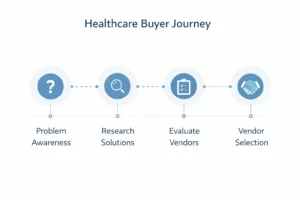
Buyers usually start with the problem, not the service
Service pages are built for people who already know what they want.
A buyer searching for “clinical trial patient recruitment services” or “oncology CRO partner” is already relatively far along in the journey. They know the category. They understand the need. They are comparing vendors.
That traffic can convert well, but it is limited.
Therapeutic area content reaches buyers much earlier, when they are still framing the problem. They are not always searching for a provider. They are often searching for insight, risk reduction, and clarity.
A biotech team may begin with questions like:
- What are the main enrollment barriers in rare disease trials?
- What makes CNS trials so operationally difficult?
- How do endpoints differ in oncology studies?
- What should sponsors look for in an immunology CRO?
- Why do gastrointestinal trials face site performance issues?
Those are not service-page searches. They are problem-led, expertise-led, therapeutic-area-led searches.
That distinction is decisive. If your website only ranks for service terms, you show up late. If it ranks for therapeutic area questions, you enter the conversation earlier, shape the buyer’s thinking, and earn trust before competitors even appear.
Therapeutic area content captures more search demand
There is also a plain SEO reality here: therapeutic area content gives you far more opportunities to be discovered.
Service pages usually target a narrow set of late-intent keywords. Therapeutic area content can target a much broader universe of searches across symptoms, conditions, treatment pathways, operational challenges, patient populations, trial design issues, regulatory considerations, and sponsor concerns.
That broader topical footprint matters because search behavior in healthcare and life sciences is highly fragmented. People do not search one way. They search in layers.
A sponsor exploring oncology outsourcing may search by:
- indication
- patient population
- trial phase
- endpoint complexity
- recruitment risk
- regulatory burden
- biomarker requirements
- geography
- previous trial failures
A generic service page cannot realistically satisfy all of that intent.
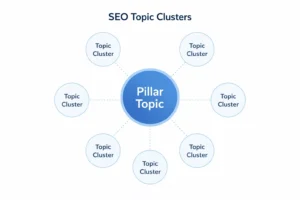
A well-built therapeutic content hub can.
This is why therapeutic area content tends to generate more total entry points into the site. It captures the long tail. It addresses adjacent questions. It supports topic clusters. And it creates the internal linking pathways that move users from education to evaluation.
Service pages are still important, but they are usually closers, not discoverers.
In healthcare, trust is built through depth, not slogans
This is where many brands lose the plot.
A service page says, “We offer patient recruitment solutions.”
A therapeutic area page explains why recruitment is uniquely difficult in neurology, what operational constraints matter, what patient behavior patterns affect enrollment, and how study design influences timelines.
Which one builds trust faster?
Obviously the second.

In health-related sectors, trust is not created by polished positioning alone. It is created by evidence of understanding. Buyers want to see that you know the landscape they operate in. They want to feel that you understand the disease context, the real-world bottlenecks, and the consequences of getting decisions wrong.
Therapeutic area content proves relevance in a way service pages rarely can.
That matters even more because health and medical topics sit in a high-trust search environment. Search engines apply stricter quality expectations to content that can affect health decisions. Users do the same. Thin, generic, promotional content is weak on both fronts.
The winners are the companies that publish content showing real expertise, clear authorship, sound structure, current information, and practical value.
In other words, therapeutic area content does not just attract traffic. It earns credibility.
Therapeutic area pages match the real decision journey
One of the dumbest assumptions in B2B healthcare marketing is that conversion begins when the buyer hits a “contact us” or “services” page.
It usually starts much earlier.
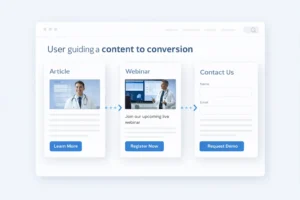
A prospect may first encounter your brand through an article on oncology trial complexity, then return later through a page on rare disease recruitment, then review your capabilities page, then look at your case studies, and only after that submit a form.

If you only value the last page before conversion, you will underestimate the real lead contribution of top- and mid-funnel content.
Therapeutic area content is often the entry point that initiates the relationship. It reduces uncertainty. It frames the problem. It helps the buyer understand what matters. And once that happens, your service pages become much more effective because the visitor is no longer cold.
This is the right way to think about the structure:
- therapeutic area content creates demand capture and trust
- service pages validate fit and capabilities
- conversion pages close the action
When companies ignore that flow, they end up with underperforming service pages and then conclude that SEO “doesn’t drive leads.” That is usually nonsense. The real issue is that the content architecture is broken.
More traffic is not enough, but therapeutic area content often produces more leads anyway
A fair objection is this: service pages may convert at a higher rate.
That is often true.
A visitor who lands on a service page is usually closer to action than a visitor reading an educational page. But that does not mean service pages generate more leads overall.
Why? Because volume matters.
Therapeutic area content often attracts substantially more organic visibility and more first-touch sessions. Even if its direct conversion rate is lower, the sheer volume of qualified entrances and assisted conversions can produce more total leads.
This is the difference between conversion rate and lead contribution.
Service pages may win on efficiency.
Therapeutic area content often wins on scale.
The best-performing websites do not force these two content types to compete. They use them together. Therapeutic content expands reach and warms the audience. Service pages capture commercial intent when the buyer is ready.
If you only invest in the second part, you starve the first.
Therapeutic area content creates better-fit leads
Not all leads are equal.
A generic service page may attract people looking for broad vendor lists, quick comparisons, or price-first solutions. Therapeutic area content, on the other hand, often attracts leads with a more specific and serious underlying need.
Someone reading a deep piece on immunology trial site selection or CNS patient retention is not casually browsing. They are often dealing with a real business problem. They are already thinking in operational or strategic terms. They are looking for expertise, not just a supplier.
That tends to improve lead quality.
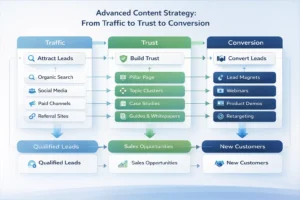
It also helps pre-qualify prospects before they ever speak to sales. By the time they reach a service page or fill out a form, they already understand your perspective and your relevance to their therapeutic area.
That is a major advantage for long sales cycles and high-consideration deals.
Search is changing, and therapeutic area content still matters
Yes, search results are changing. More answers appear directly in the SERP. AI-generated summaries reduce clicks in some categories. Organic traffic is more contested than it used to be.
But this is not an argument against therapeutic area content. It is an argument for building it better.
The role of therapeutic area content is no longer just to win clicks. It is to build visibility, credibility, recall, and progression. It must be created with stronger information design, sharper positioning, and clearer conversion paths.
That means every therapeutic area page should do more than educate. It should guide.
A strong page should answer the user’s question and then show them what to do next:
- explore relevant services
- review a case study
- speak to an expert
- assess study feasibility
- download a framework
- request a consultation
Too many companies publish educational content and then abandon the visitor with no logical next step. That is amateur work. Good content strategy connects information to action.
Why service pages alone usually underperform
Let’s be blunt: most service pages are too generic to win meaningful search visibility or buyer trust on their own.
They tend to have the same problems:
- vague positioning
- weak differentiation
- thin content
- little evidence of domain expertise
- poor alignment with specific user intent
- no clear bridge from information to conversion
They talk about capabilities in broad language, but they do not demonstrate understanding of the therapeutic context in which those capabilities matter.
That is why many service pages struggle to rank, struggle to engage, and struggle to convert unless they are supported by a wider topical ecosystem.
Therapeutic area content gives them that support.
It builds topical authority.
It creates internal linking strength.
It feeds branded search.
It gives sales prospects something useful to consume before outreach.
It turns a brochure-style website into a demand-generation asset.
Without that layer, service pages are often just static commercial pages waiting for traffic that never arrives.
What this means for CROs and healthcare marketers
If you are marketing in a complex healthcare or life sciences niche, your content strategy should not start with services. It should start with buyer reality.
Ask:
- What does our audience worry about before they start vendor evaluation?
- Which therapeutic areas carry the highest commercial value for us?
- What problems, questions, and risks do buyers search within those areas?
- Where can we demonstrate expertise that competitors only claim?
Then build content clusters around those answers.
A strong structure usually looks like this:
- A therapeutic area hub page
- Supporting articles around trial design, recruitment, compliance, endpoints, patient burden, or treatment complexity
- Contextual links into relevant service pages
- Conversion points tailored to the topic
- Supporting proof such as case studies, experts, outcomes, or frameworks
That is how content actually drives pipeline.
Not with disconnected blog posts.
Not with shallow service copy.
Not with random keyword stuffing.
With a system.
The real takeaway
Therapeutic area content drives more leads than service pages because it does three things service pages rarely do by themselves:
It reaches buyers earlier.
It builds trust faster.
It creates more qualified pathways into conversion.
Service pages still matter. They are essential for validation and closing intent. But they are rarely enough to create scalable organic demand on their own.
If you want more leads, do not just describe your services better.
Demonstrate that you understand the problems buyers are trying to solve inside specific therapeutic areas. That is where search visibility grows, trust compounds, and better leads begin.
Need help building a content strategy that actually drives pipeline?
At Demand Enchance, we help healthcare, biotech, and CRO brands build content systems that do more than generate traffic. We create strategies designed to attract the right audience, strengthen topical authority, and turn organic visibility into real commercial opportunities.
That includes:
- therapeutic area content strategy
- SEO architecture for healthcare and life sciences sites
- high-intent content planning
- service-page and topic-cluster optimization
- conversion-focused content execution
If your website is full of service pages but not generating enough qualified leads, that is not bad luck. It is usually a strategy problem.
Demand Enchance helps fix that.