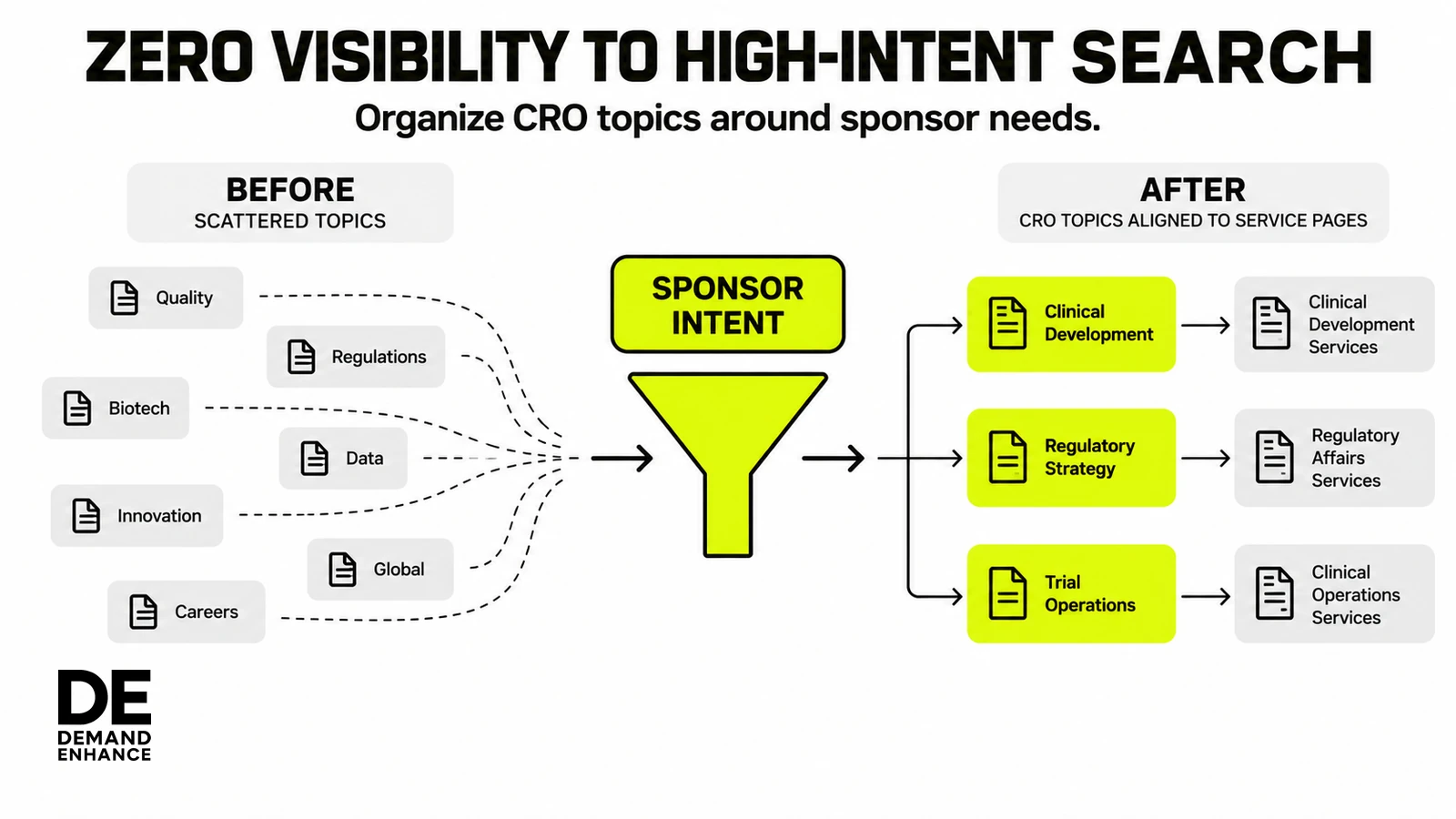
Most CRO and biotech companies do not have a traffic problem first. They have a relevance problem.
They publish a few service pages, add generic copy about clinical operations, maybe write occasional blog posts, and then wonder why organic traffic stays flat. Even worse, when traffic does arrive, it often comes from low-intent queries that never turn into pipeline.
That is exactly why the real SEO opportunity for CROs is not “more traffic.” It is more qualified traffic from the right searches at the right stage of the buying journey.
This case study framework shows how a CRO can move from near-zero organic visibility to a steady flow of high-intent traffic by combining technical SEO, intent-driven content, and conversion-focused page strategy.
The Starting Point: No Visibility, No Qualified Demand
A typical CRO website that struggles with SEO usually has the same set of issues:
The site architecture is built around internal departments rather than buyer intent. Service pages are thin, generic, and interchangeable. There is little or no topical depth around therapeutic areas, trial phases, patient recruitment, regulatory strategy, or sponsor-side operational concerns. Internal linking is weak. Valuable pages sit too deep in the site structure. Measurement is incomplete, so there is no clear picture of how organic traffic contributes to leads.
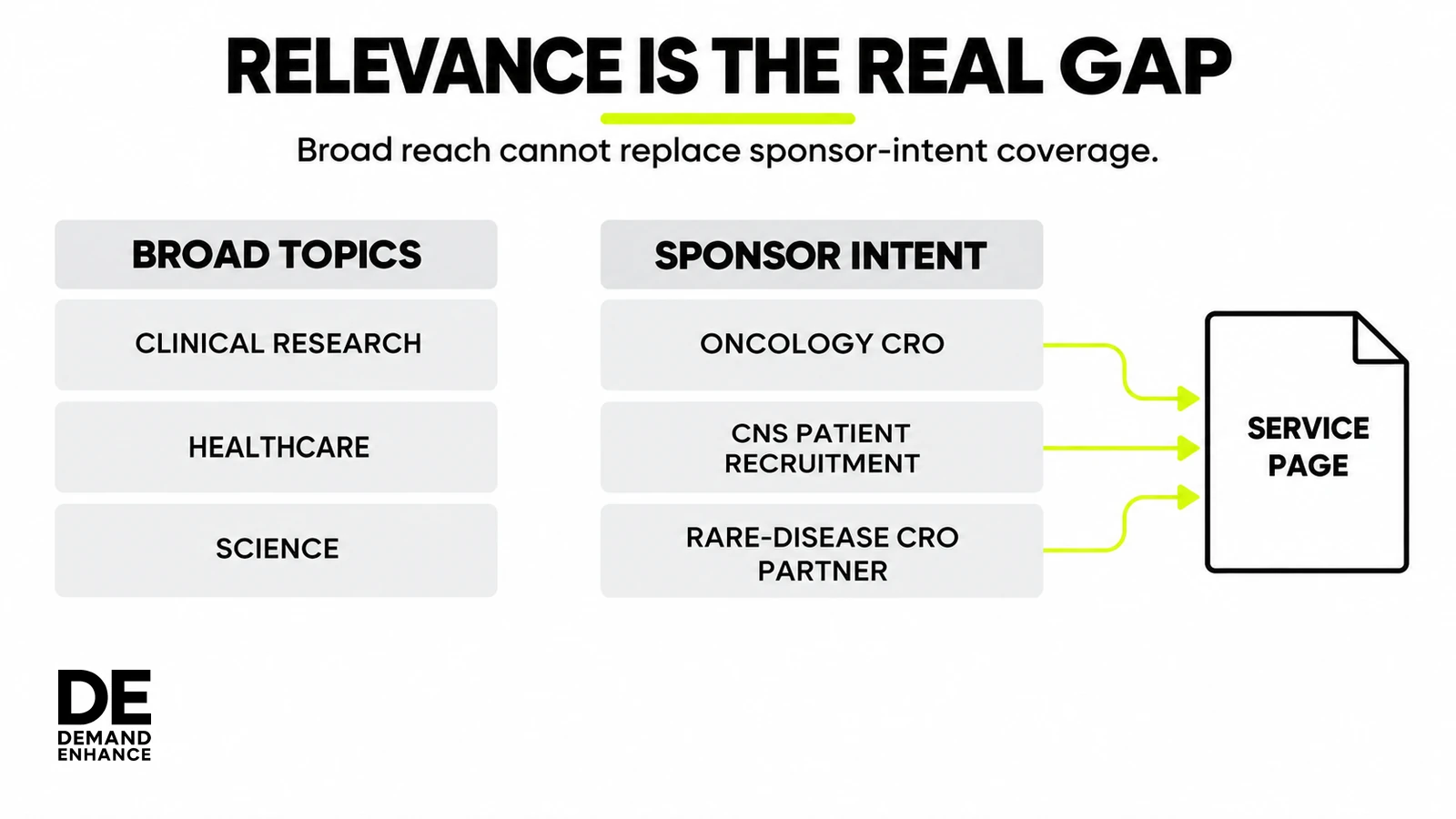
In practical terms, that means the site is almost invisible for the searches that matter, such as:
- oncology CRO for phase 2 trial
- CNS patient recruitment strategies
- rare disease CRO partner selection
- biotech clinical operations outsourcing
- CRO for small biotech companies
- FSP vs full-service CRO
These are not vanity keywords. These are commercial-intent and pre-conversion searches. They indicate that the buyer is actively evaluating solutions, partners, or delivery models.
That is the traffic a CRO should want.
The Real SEO Goal for CROs
For a CRO, SEO should not be treated as a publishing machine. That mindset produces useless content and bloated websites.
The goal is simpler and far more valuable:
Build search visibility around the exact problems, services, and therapeutic questions that qualified sponsors search before they shortlist vendors.
That means the SEO strategy has to align with three realities:
First, Google rewards pages that are genuinely useful, technically accessible, and clearly aligned with search intent.
Second, modern search behavior is fragmented. Informational traffic alone is less valuable than it used to be, especially when SERPs increasingly absorb simple top-of-funnel questions.
Third, CRO buyers do not convert because they landed on a generic “Our Services” page. They convert because a website proves expertise, reduces uncertainty, and matches the problem they are trying to solve.
That is where SEO and CRO discipline have to work together.
Phase 1: Fix the Foundation Before Scaling Content
A CRO coming from zero visibility should start with the basics, because without crawlability, indexation, and clean site structure, content production is mostly wasted effort.
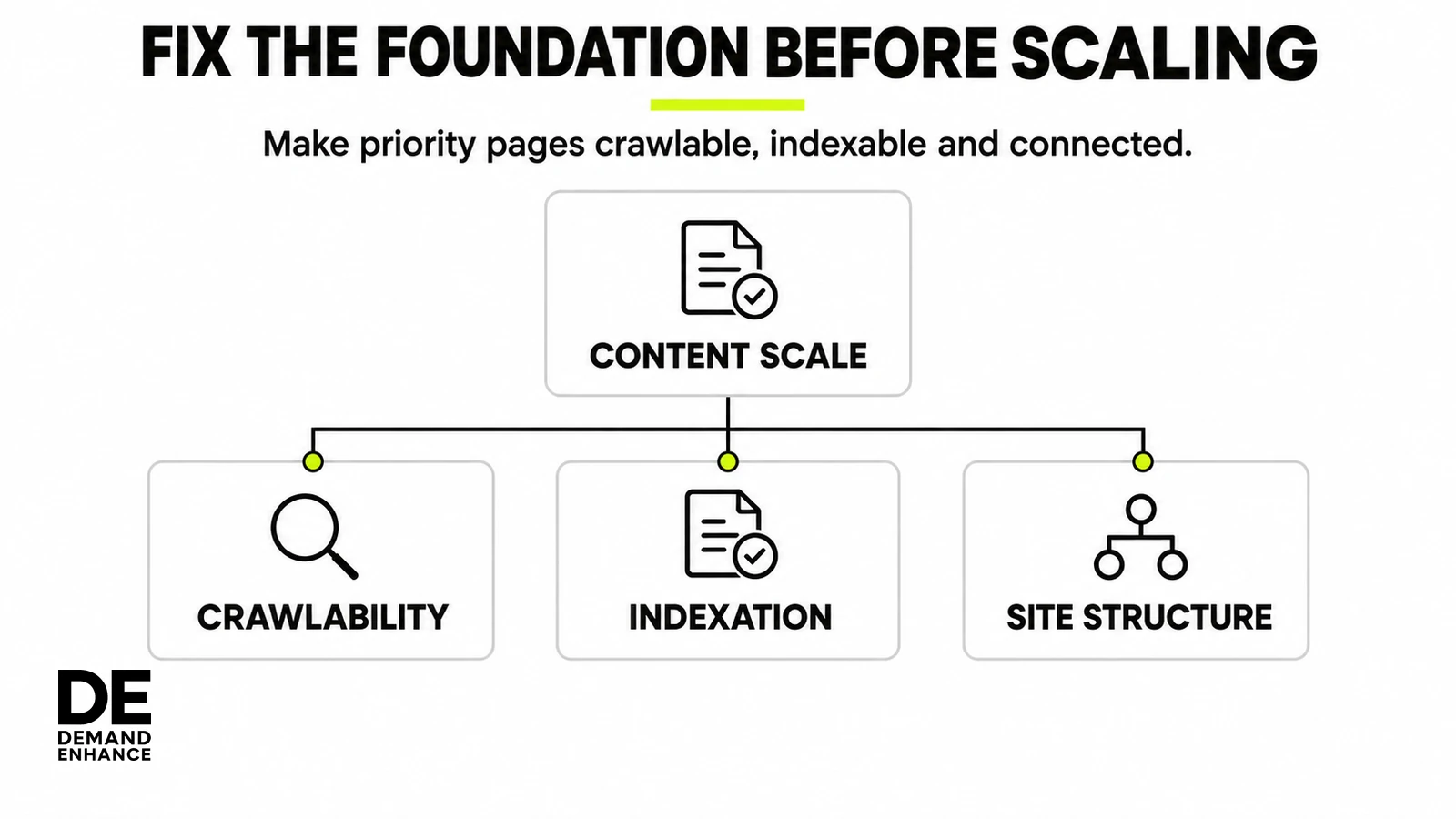
The first priority is making sure Google can properly discover, understand, and prioritize the pages that matter. In many weak CRO sites, the money pages are not structurally important enough. Important service pages are buried, orphaned, or diluted by poor navigation and weak internal linking.
At this stage, the work typically includes:
- cleaning up indexation issues
- improving internal linking to key service and solution pages
- consolidating duplicate or thin content
- strengthening page hierarchy
- improving performance and page experience
- setting up clean measurement in Google Search Console and GA4
If the site cannot reliably get the right pages crawled, indexed, and understood, content will not save it.
Phase 2: Rebuild Keyword Strategy Around Buyer Intent
This is where most CRO SEO strategies fail.
They chase broad industry terms with informational appeal but weak buying intent. That creates traffic reports that look busy and sales pipelines that stay empty.
A serious CRO SEO strategy should group keywords into intent buckets:
Informational intent includes early-stage educational searches, such as questions about trial design, regulatory pathways, or enrollment challenges.
Commercial intent includes comparison and evaluation searches, where a buyer is assessing service models, therapeutic specialization, or partner fit.
Transactional or decision-stage intent includes queries directly tied to vendor selection, outsourcing, or proposal-stage evaluation.
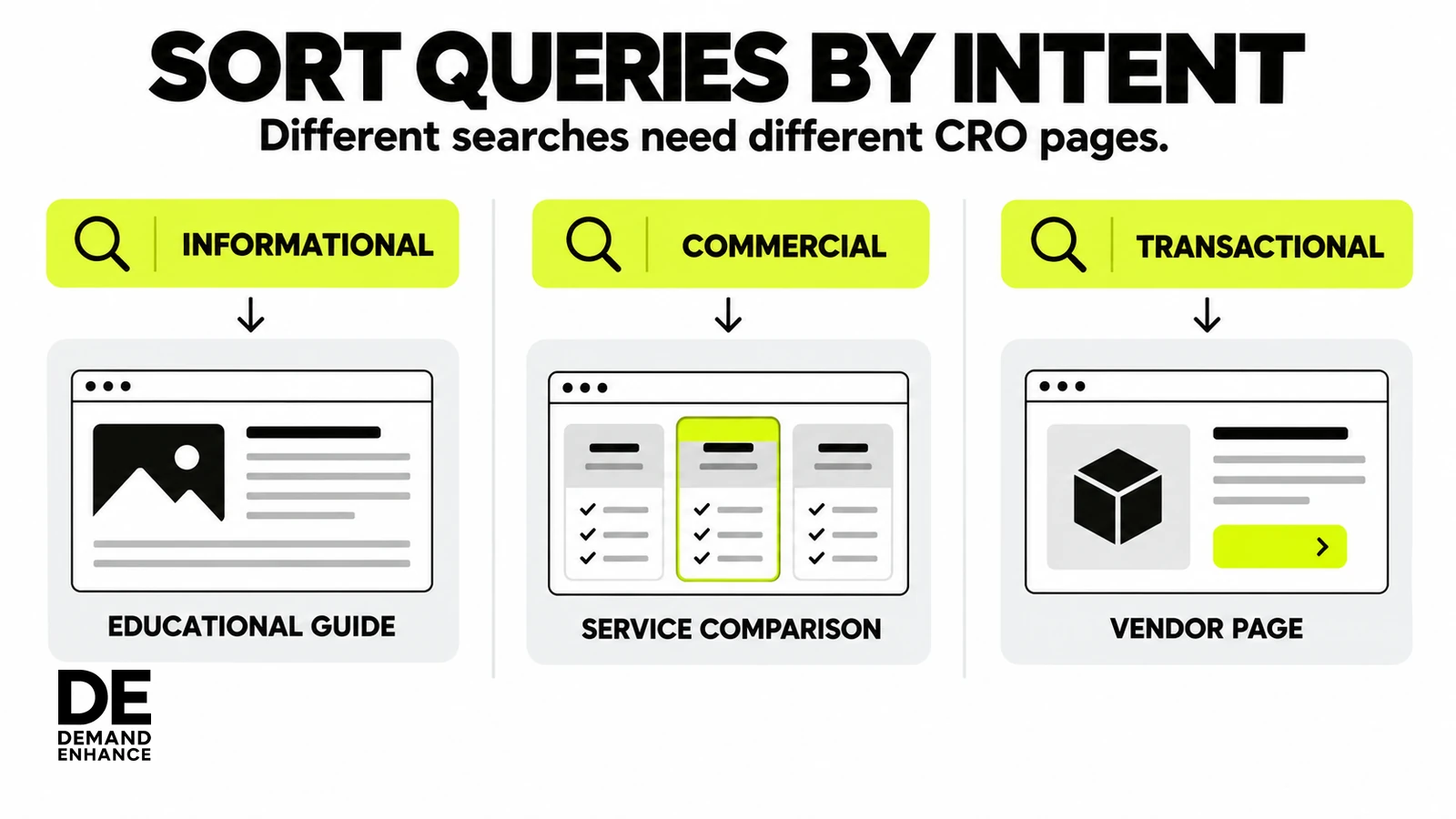
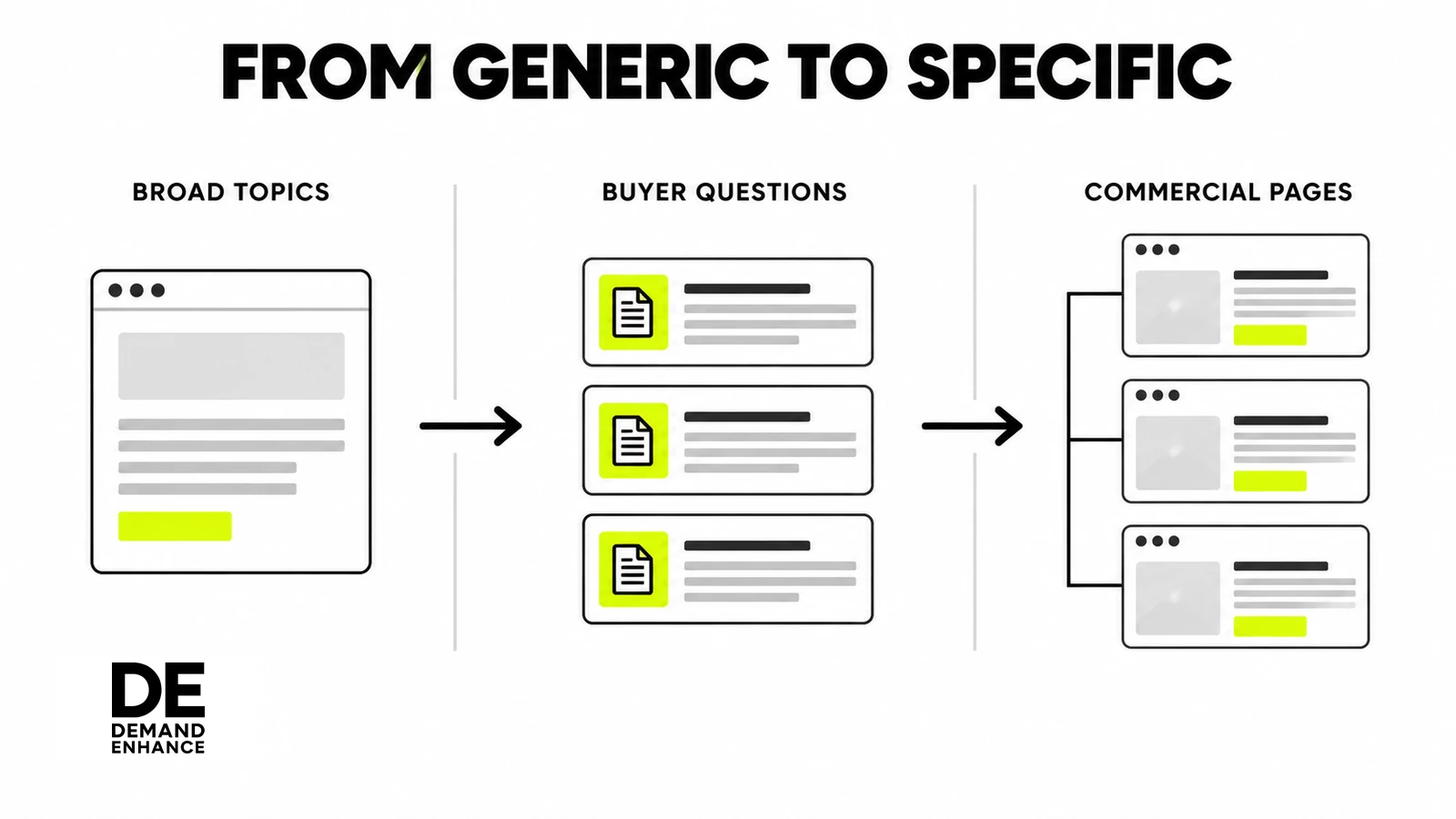
For example, a CRO should not just target “clinical trial recruitment.” That is too broad and too vague on its own.
A better strategy is to build clusters around more specific, high-intent themes such as:
- oncology patient recruitment vendor
- decentralized trial support for biotech
- CRO for rare disease studies
- phase 1 clinical pharmacology CRO
- global study startup support
- FSP model for biotech sponsors
That shift matters because it changes the type of traffic entering the site. Instead of attracting students, job seekers, and random researchers, the site begins attracting operations teams, biotech decision-makers, and procurement-influencing stakeholders.
That is the difference between visibility and commercial visibility.
Phase 3: Create Pages That Match How Sponsors Actually Search
Once intent is mapped, the next move is not “write more blogs.”
The next move is to build the right page types.
A CRO that wants qualified organic leads needs a content architecture built around three layers.
The first layer is high-intent service and solution pages. These are pages for actual commercial entry points: therapeutic area capabilities, service-line pages, trial phase expertise, outsourcing models, regional delivery, and operational specializations.
The second layer is decision-support content. This includes pages like comparisons, buyer guides, evaluation checklists, FAQs, and case-study-style pages that help sponsors choose a partner with confidence.
The third layer is informational content that feeds the other two layers. This is where educational articles work well, but only if they route users toward commercial pages rather than existing as isolated blog clutter.
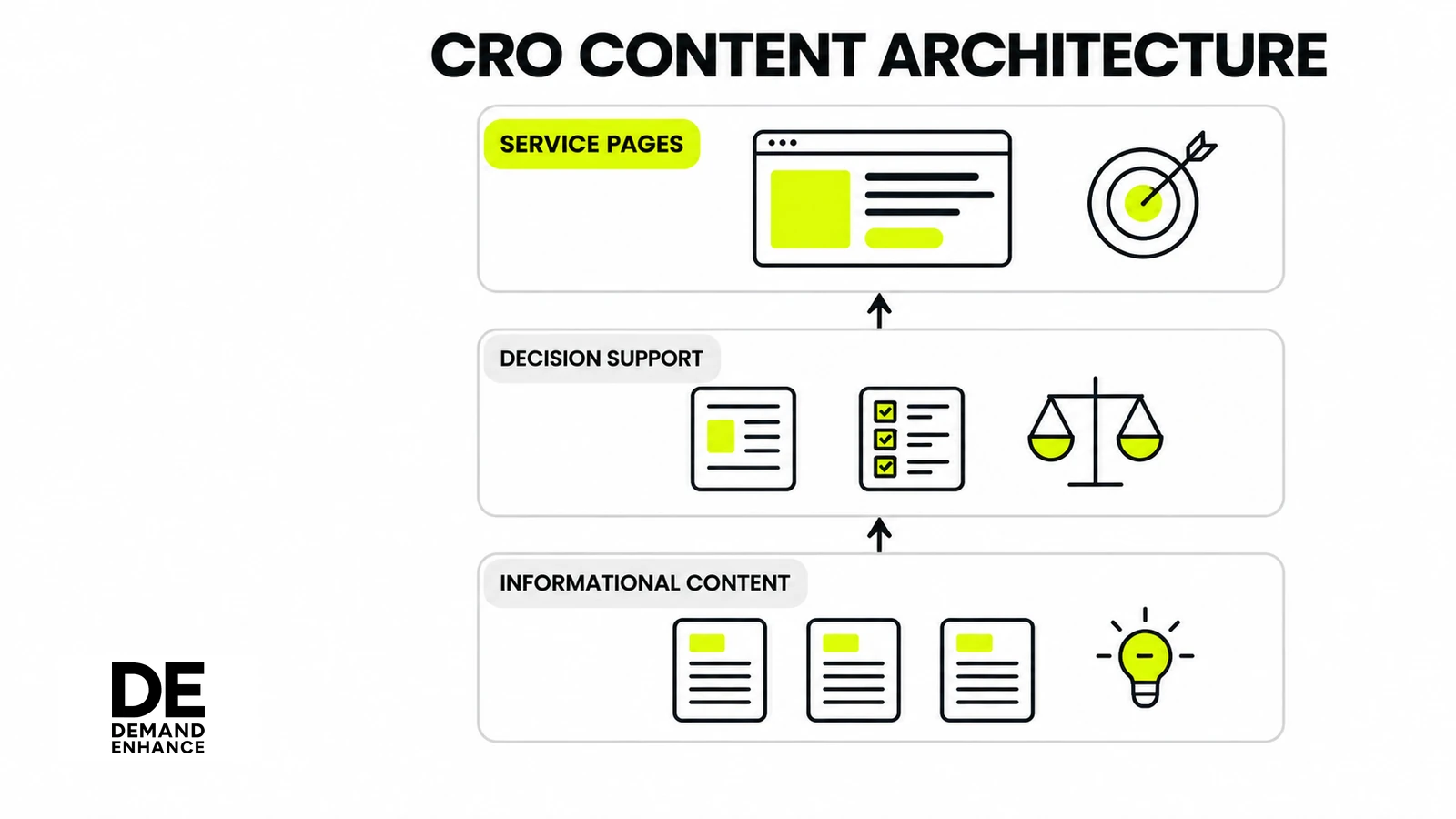
For example, instead of publishing another vague article on “What Is a CRO?”, a stronger content ecosystem would look like this:
A commercial page on Oncology CRO Services for Emerging Biotech Sponsors.
A supporting page on How to Evaluate an Oncology CRO for Phase 1–2 Programs.
An educational article on Common Enrollment Risks in Early-Phase Oncology Trials.
Those assets reinforce each other. They create topical authority, support internal linking, and move searchers from problem awareness to partner evaluation.
That is how high-intent traffic compounds.
Set a CRO SEO baseline
- Identify which priority service and solution pages are indexed, linked from navigation, and reachable without excessive site depth.
- Group relevant queries by sponsor intent and confirm that each planned page addresses a distinct, supportable capability or buyer question.
- Document current visibility, landing-page activity, and inquiry definitions before describing any change as a business outcome.
Put the idea into practice
Choose what to fix first
A CRO sees low-intent organic visits and weak sponsor engagement; where should its next effort go?
Broaden traffic topics
This may be appropriate when the current audience is well defined and existing pages already serve sponsor needs. If the main problem is relevance, more broad topics can increase activity without clarifying which pages support commercial decisions.
Narrow to sponsor intent
Choose this when current pages attract visitors whose needs do not match the CRO's services. Map specific sponsor questions to suitable pages and evidence, then track qualified engagement without assuming that traffic alone predicts pipeline.
Plan a relevance-focused review
Establish the baseline
Review indexation, internal links, landing pages, query themes, and inquiry records; document tracking gaps and set the comparison period before evaluating current performance with agreed definitions.
Map intent to pages
Separate educational, comparison, and decision-stage questions, then assign each to a page format that can answer the need and connect to verified capability evidence, without duplicating existing resources.
Review the signals
Compare search visibility, relevant page engagement, and qualified inquiries over the agreed period; describe missing data, attribution limits, and the decision criteria before interpreting results.
Phase 4: Turn Traffic Into Pipeline, Not Just Sessions
This is the part many SEO teams still mishandle.
They celebrate rankings, impressions, and traffic growth while ignoring whether the page actually helps a buyer take the next step.
For CROs, conversion optimization is not about flashy buttons or shallow A/B testing culture. It is about reducing friction for serious buyers.
That means every high-intent page should answer the questions that matter most:
Why should a sponsor trust this CRO with this type of study?
What specific expertise does the company bring?
What evidence supports that expertise?
What delivery model or geographic footprint is relevant?
What should the visitor do next if they want to evaluate fit?
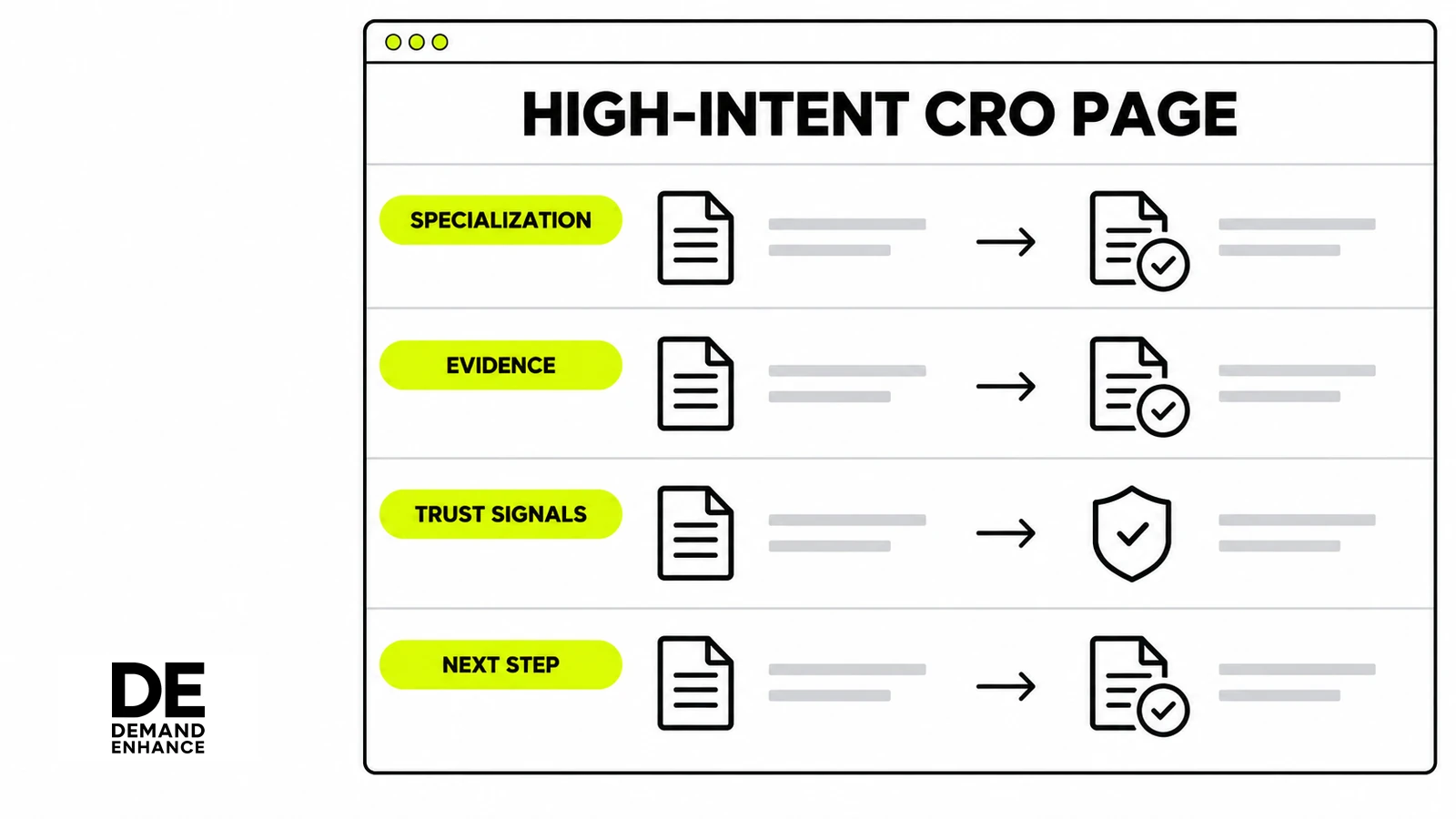
A high-performing CRO landing page usually does a few things exceptionally well:
It communicates specialization fast.
It uses real proof, not empty claims.
It makes the next action obvious.
It reduces uncertainty around capability, scope, and fit.
That proof can include therapeutic focus, operational track record, delivery regions, modality experience, enrollment capabilities, study startup performance, or clearly positioned service models.
A weak CRO page says, “We deliver innovative clinical solutions.”
A strong CRO page says, “We support early-phase oncology sponsors with patient recruitment, site activation, and cross-functional clinical operations across North America and Europe.”
One of those statements sounds like a website. The other sounds like a partner.
What Success Looks Like
A CRO moving from zero visibility to high-intent traffic should not judge success only by raw sessions.
That is lazy reporting.
The better success pattern looks like this:
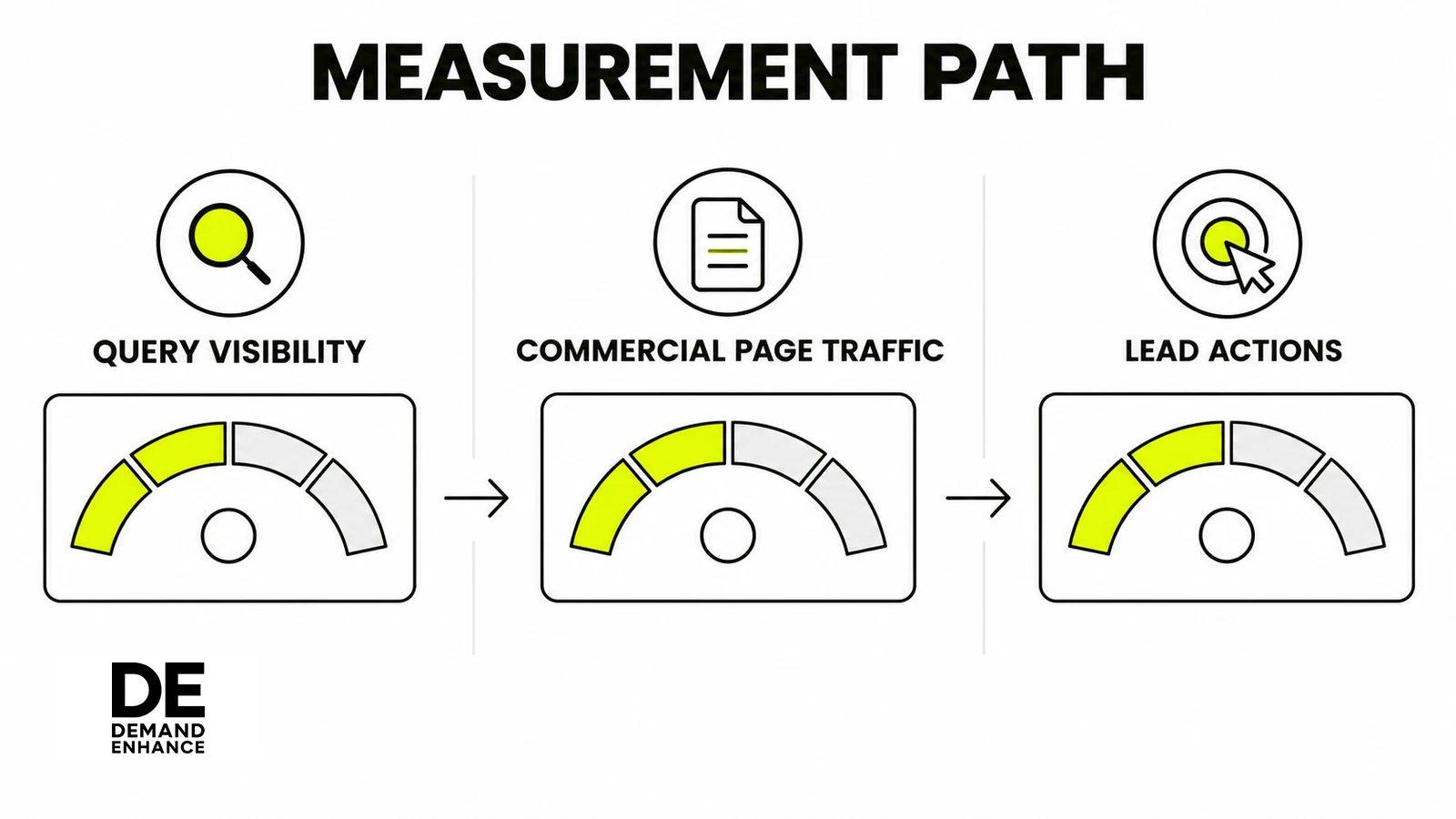
At first, impressions rise for targeted non-branded queries tied to service and therapeutic expertise.
Then rankings improve for mid-funnel and bottom-funnel pages.
Then organic traffic begins landing on commercial pages rather than just blog posts.
Then engagement improves because the pages better match intent.
Then lead actions increase: contact forms, consultation requests, capability deck requests, meeting bookings, or tracked sales inquiries.
That is the real progression.
Not every CRO will see explosive traffic. And frankly, that is fine. This is a niche B2B market. The goal is not to become a media company. The goal is to become discoverable where serious buyers are already looking.
A smaller volume of high-intent traffic can outperform a much larger volume of generic traffic by a ridiculous margin.
A Practical Example of the Transformation
Let’s simplify the journey into a realistic before-and-after model.
Before the SEO rebuild, the CRO website has:
- a few thin service pages
- weak visibility outside branded search
- little topical depth
- low engagement on organic landings
- no meaningful organic lead flow
After a focused SEO and CRO program, the site has:
- therapeutic area pages built around actual sponsor search behavior
- commercial-intent clusters targeting outsourcing and evaluation queries
- internal linking that routes informational traffic into solution pages
- stronger proof and clearer CTAs on high-intent pages
- measurable growth in qualified organic sessions and lead actions
The most important shift is not just that traffic increased. It is that the type of traffic changed.
That is the whole game.
Why This Matters More in 2026 and Beyond
Search is getting harder, not easier.
Top-of-funnel clicks are less dependable. Generic content is less defensible. AI-generated content is flooding the web. And buyers are more selective than ever.
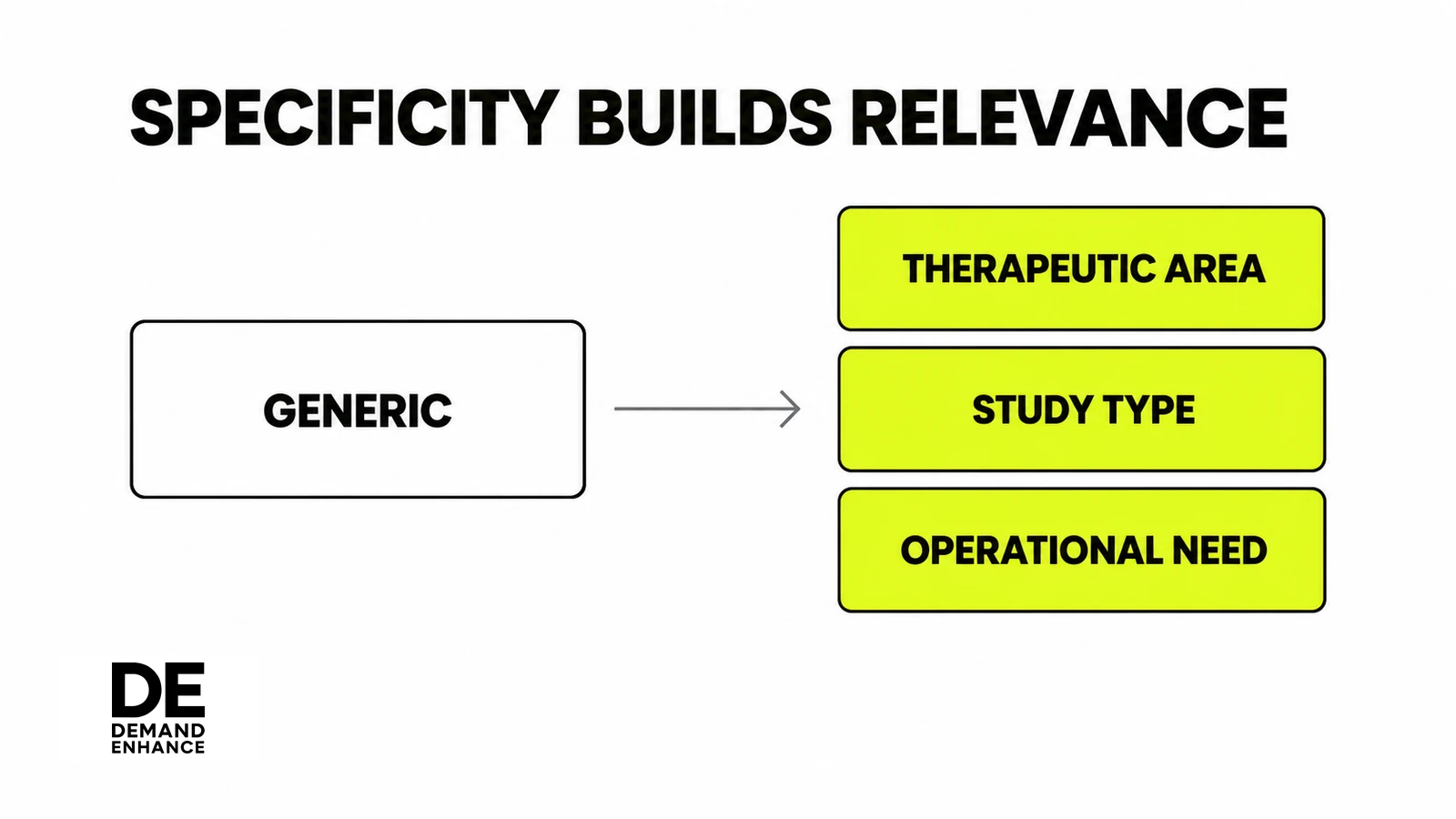
That creates a huge opening for CROs that are willing to be specific.
Specific about who they serve.
Specific about what they do best.
Specific about study types, therapeutic strengths, delivery models, and sponsor pain points.
In SEO, specificity wins. In CRO marketing, specificity converts.
If a CRO wants to move from invisible to in-demand, the path is not complicated. But it does require discipline:
Fix the technical foundation.
Map content to real intent.
Build pages for decision-stage searches.
Strengthen proof and conversion pathways.
Measure business outcomes, not vanity metrics.
That is how you go from zero visibility to high-intent traffic.
Final Takeaway
The strongest CRO SEO strategies do not begin with content calendars. They begin with buyer intent.
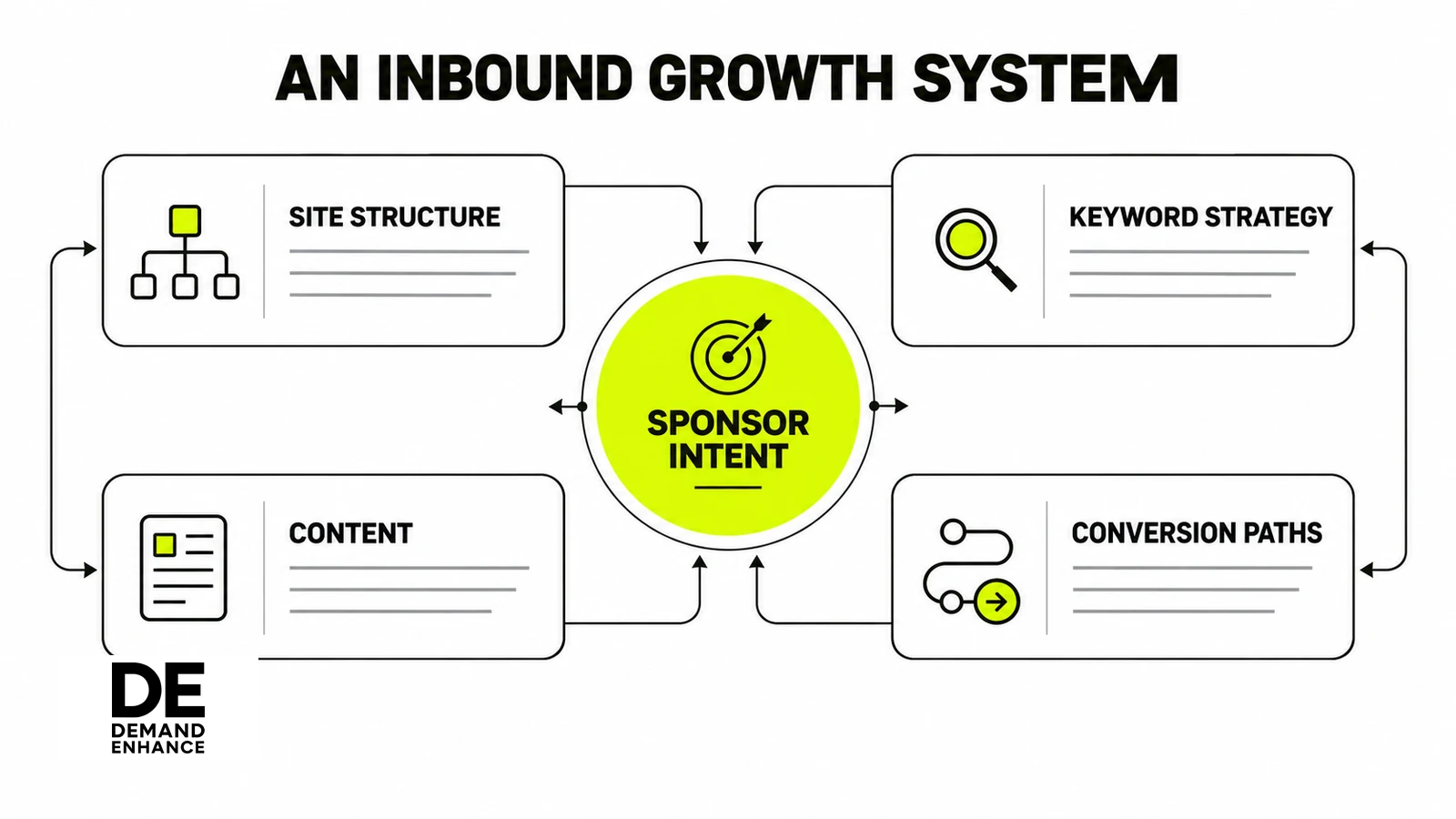
When the site structure, keyword strategy, content architecture, and conversion paths all align around what sponsors are actually searching for, organic traffic stops being random and starts becoming commercially useful.
That is the difference between “doing SEO” and building an inbound growth system.
And if your CRO website is still relying on generic service pages and broad blog content, then yes, I’ll say it directly: that approach is too weak for the market you are competing in.
Need Help Building This for Your CRO?
If you want to turn your CRO website into a real source of qualified inbound demand, Demand Enchance can help.
Demand Enchance supports companies that need sharper SEO strategy, stronger commercial content, and clearer conversion pathways, especially in complex B2B sectors where trust, expertise, and intent matter more than traffic volume alone.
Whether you are starting from zero visibility or trying to turn existing traffic into actual pipeline, Demand Enchance can help you build an SEO system that attracts the right audience and moves them closer to action.
Frequently asked questions
How should an illustrative SEO framework be distinguished from a documented case study?
Label illustrative examples clearly and reserve case-study language for work supported by verifiable client evidence and permission to publish. State the context, actions, and measured results only when records support them; never imply outcomes from a hypothetical framework.
Which signals can show that CRO search visibility is becoming more relevant?
Look beyond total visits to query themes, landing-page relevance, engagement with capability resources, and inquiries that match the intended sponsor profile. Where systems permit, connect these observations with CRM qualification while stating the attribution limits.
What should a CRO address before expanding its SEO content?
Check whether priority pages can be found, crawled, and understood; whether page topics match real buyer needs; and whether useful evidence supports the claims. Resolve structural and measurement gaps before scaling a content programme.
Sources and further reading
Demand Enhance
Separate the baseline from the example
Review your current search baseline, priority pages, and available lead evidence with Demand Enhance. Use documented data to decide which content gaps merit attention and which claims need clearer qualification.
Discuss your priorities