Clinical Research Organizations are entering a new search environment.
For years, SEO for CROs followed a familiar model: build service pages, publish educational content, optimize for Google, earn backlinks, and convert qualified visitors into inquiries. That model still matters. But it is no longer enough.
Sponsors, biotech founders, clinical operations teams, procurement stakeholders, and pharma decision-makers are now using AI-powered search tools to research vendors, compare clinical research partners, evaluate therapeutic expertise, and build shortlists before they ever speak to a sales team.
A biotech founder may ask ChatGPT what to look for in a CRO for a Phase II oncology trial. A clinical operations leader may use Perplexity to compare decentralized trial vendors. A procurement team may rely on Google’s AI-generated results to understand which capabilities matter when evaluating a rare disease CRO.
In this environment, your website is no longer assessed only by whether it ranks for a keyword.
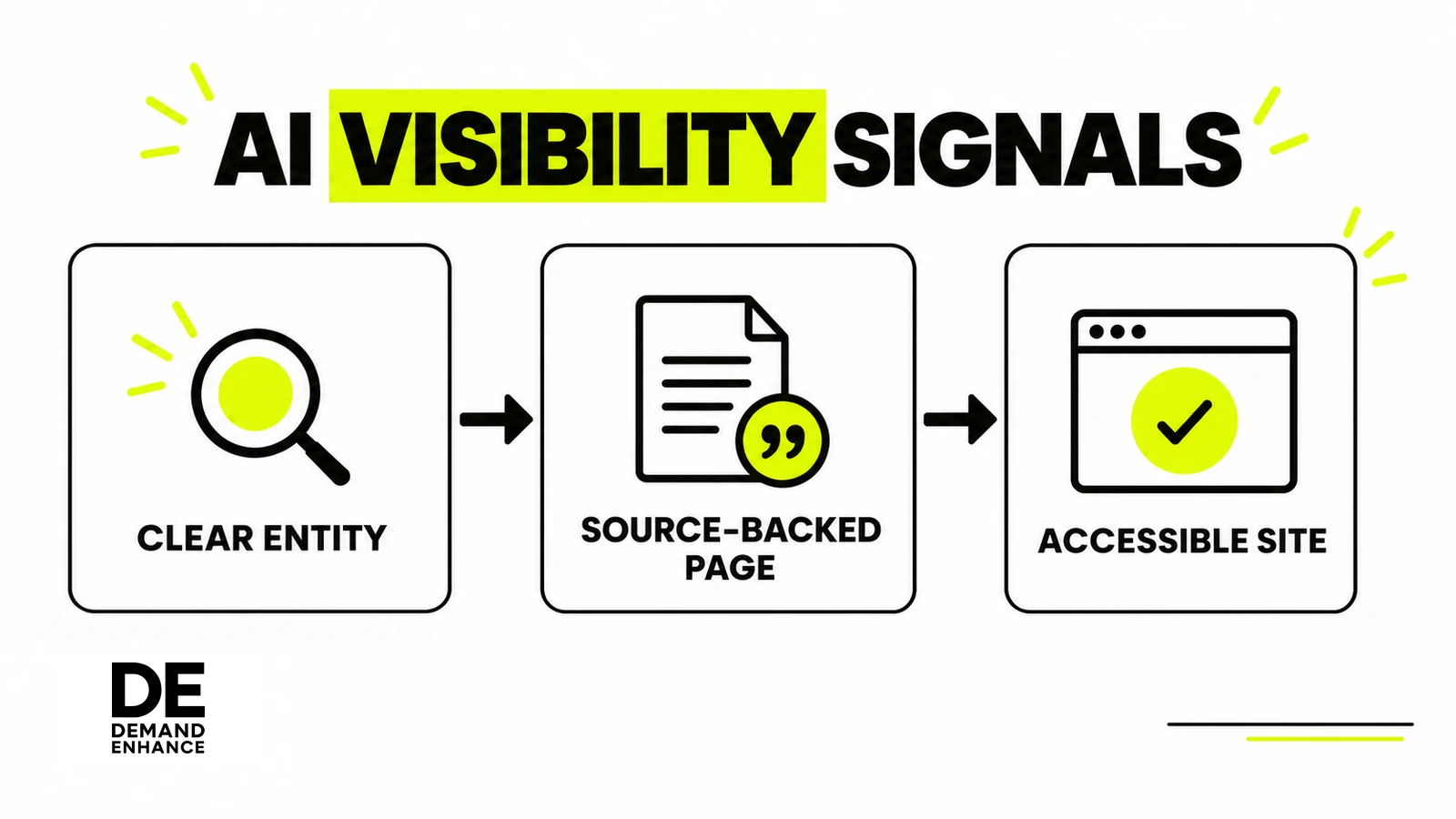
It is assessed by whether it can be understood, trusted, and recommended.
That is the central shift CROs need to take seriously. AI search does not reward vague claims of expertise. It rewards clear, structured, evidence-backed information that can be extracted, summarized, and connected to specific sponsor needs.
The CROs that win in AI search will not necessarily be the ones publishing the highest volume of content. They will be the ones whose websites make their expertise easiest to verify.
The problem with most CRO websites
Many CRO websites are built like digital brochures.
They look polished. They use familiar language around innovation, patient-centricity, operational excellence, global capabilities, quality, and therapeutic expertise. They usually include service pages for clinical trial management, patient recruitment, regulatory support, data management, medical writing, site feasibility, and related services.
On the surface, that may look complete.
But when an AI system, search engine, or sponsor tries to understand the company in detail, the content often becomes thin.
A sentence like:
“We provide end-to-end clinical trial solutions across multiple therapeutic areas.”
may sound acceptable in a capabilities deck, but it gives very little useful information.
It does not explain which therapeutic areas matter most. It does not clarify which trial phases the CRO supports. It does not show what kind of sponsor is the best fit. It does not prove operational experience. It does not connect services to real clinical development challenges.
This is why many CRO websites are weaker than they appear.
They are designed to impress, but not necessarily to explain.
That distinction matters far more in AI search than it did in traditional SEO. A human visitor may infer credibility from branding, design, and confident language. AI systems need more explicit signals. They need to understand the relationships between services, therapeutic areas, trial phases, sponsor types, geographies, experts, case studies, and decision criteria.
If those relationships are missing, a CRO may still have some Google visibility, but remain largely absent from AI-assisted evaluation.
The first change is not technical
The instinctive reaction to AI search is often technical.
Add schema. Add an AI chatbot. Add more FAQ sections. Add structured data. Add an LLM-powered search function. Publish more content.
Some of those actions can help. But they are not the right starting point.
The first change should be strategic: your website must move from describing capabilities to proving relevance.
That is a major difference.
A standard CRO website says:
“We offer patient recruitment services.”
An AI-ready CRO website explains when recruitment becomes difficult, which trial types create the highest enrollment risk, how patient pathways differ by therapeutic area, how site feasibility influences recruitment performance, what role patient-facing materials play, and what evidence shows that the CRO can solve these challenges.
This is what I would call the CRO Evidence Layer.
It is the layer of content that connects your claims to proof.
Without it, your website is simply making statements. With it, your website becomes easier for Google, AI Overviews, ChatGPT, Perplexity, and other AI-driven systems to interpret as a credible source.
What the CRO Evidence Layer should include
Most CRO websites are organized around services. That makes sense internally, but it is not always how sponsors search, evaluate, or make decisions.
Sponsors rarely begin with a clean service category. They begin with a clinical, operational, or commercial problem.
They need to recruit patients for a difficult oncology study. They need to understand whether a CRO has experience in rare disease trials. They need support for a Phase II study across selected European markets. They need feasibility input before protocol finalization. They need operational expertise, but not necessarily a full-service CRO model.
AI search mirrors this behavior. Users ask complex, context-rich questions. They do not always search for “clinical trial management services.” They ask what to look for, how to compare partners, which risks matter, and what experience is relevant.
That means CRO websites need to show not only what the company does, but where its expertise applies.
A strong CRO Evidence Layer connects five elements:
service, therapeutic area, trial phase, sponsor situation, and proof.
For example, a weak page says:
“We support oncology clinical trials.”
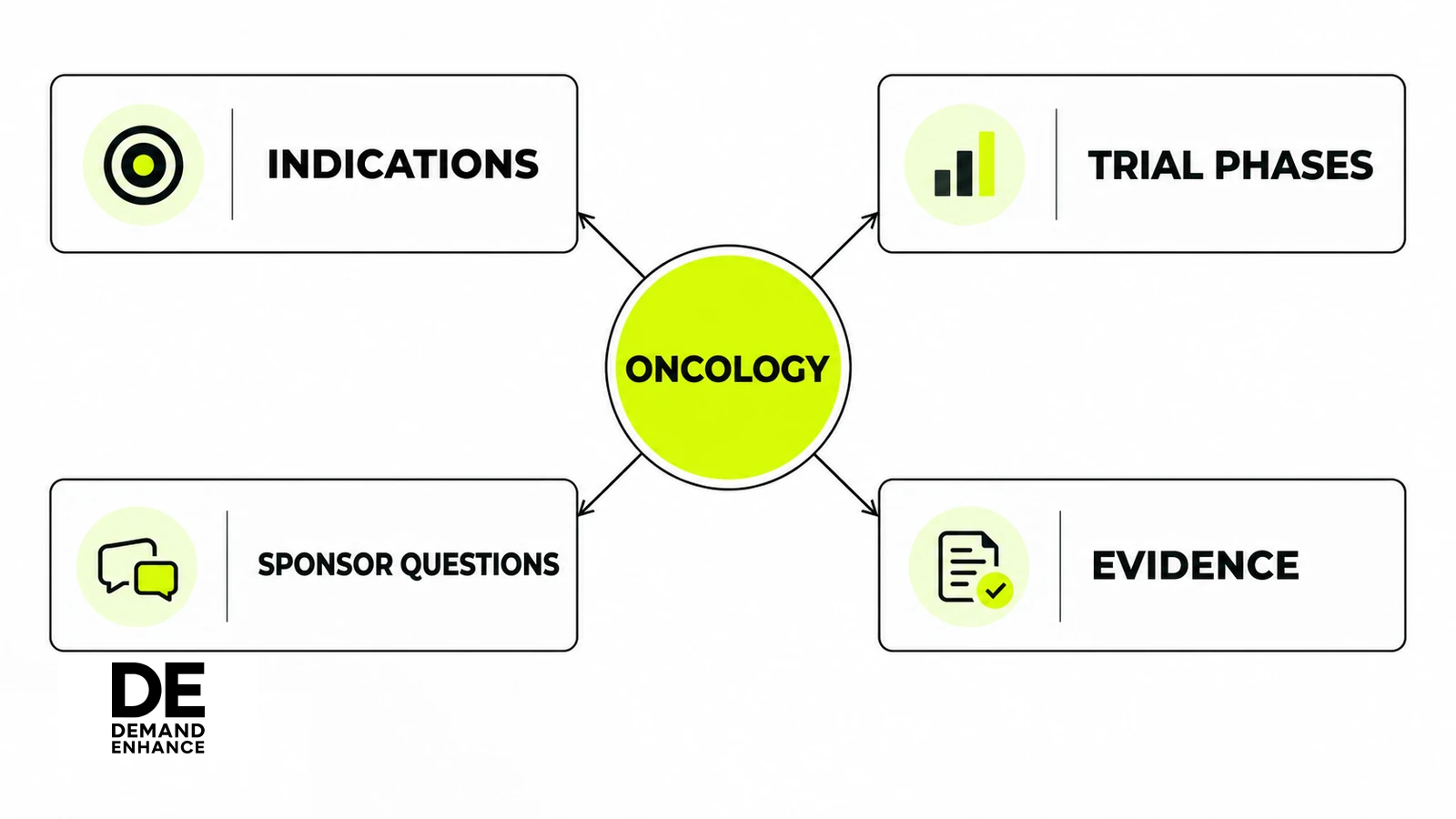
A stronger page explains that oncology trials often involve complex protocols, competitive recruitment environments, biomarker-driven eligibility, specialized sites, demanding timelines, and high sponsor scrutiny. It then shows how the CRO supports feasibility, site identification, recruitment strategy, vendor coordination, study startup, and operational delivery in that specific context.
The difference is not simply more content.
It is better evidence architecture.
Service pages need to become decision-support pages
Most CRO service pages are too self-focused.
They explain what the company offers, but they do not help a sponsor make a decision.
That is a missed opportunity.
A sponsor evaluating a CRO is not only asking:
“Do they offer this service?”
They are asking:
“Can they handle our specific type of study?”
“Do they understand the operational risks?”
“Have they worked with organizations like ours?”
“Will they know what to do if recruitment slows down?”
“Can they support our phase, geography, indication, and internal team structure?”
A strong service page should answer those questions directly.
A clinical trial management page, for example, should not stop at broad claims about operational excellence. It should clarify which study phases the CRO supports, what type of sponsors it works with, how the team manages timelines, how it coordinates vendors, how risks are identified, and where its strongest therapeutic experience sits.
This is better for AI search because it gives machines more specific information to extract and summarize.
It is also better for conversion because it gives sponsors fewer reasons to leave the site and compare elsewhere.
The practical shift is simple:
Stop writing service pages as sales descriptions.
Start writing them as sponsor evaluation assets.
Review a CRO evidence layer
- Choose a priority service and name the sponsor type, study context, therapeutic area, and phase the page can support.
- Replace broad claims with verifiable scope, process, evidence, expert context, and relevant links that help a sponsor assess fit.
- Check that any anonymized case example is approved, clearly contextualized, and free of unsupported outcome claims.
Put the idea into practice
Choose where to improve first
A CRO wants to appear more clearly in AI-assisted evaluation; which page task comes first?
Add more schema
Use markup when it accurately describes visible page information and the underlying content is already clear. If the page still relies on vague claims, first make its service scope, audience, expertise, and supporting evidence understandable.
Clarify service evidence
Choose this when sponsors cannot tell which study contexts or needs the service supports. Explain the fit, process, and approved proof first; add structured data later to describe those visible relationships accurately, before expanding the same template.
Strengthen one decision page
Select the page
Choose a service page that matters to sponsor evaluation and define the intended audience, study context, therapeutic area, and phase using the organization's actual capabilities.
Connect the evidence
Add approved detail about scope, process, expertise, and proof; identify limitations or confidential details, then explain how the information relates to the sponsor audience and intended page.
Link supporting assets
Connect the page to relevant case material, expert profiles, and sponsor resources, then review whether the next action is clear and appropriate to the reader.
Therapeutic area content is where CROs can build real authority
For AI search, therapeutic area content may become one of the most important visibility assets for CROs.
Many clinical research companies still treat therapeutic areas as a list:
Oncology. CNS. Rare disease. Cardiology. Immunology. Dermatology.
That may be acceptable in a capabilities deck, but it is weak for organic visibility, AI search, and sponsor trust.
A list does not prove expertise.
If oncology is a priority for the CRO, the website should include a serious oncology content hub. It should explain protocol complexity, recruitment barriers, site feasibility challenges, patient population constraints, endpoint considerations, operational risks, and sponsor decision criteria.
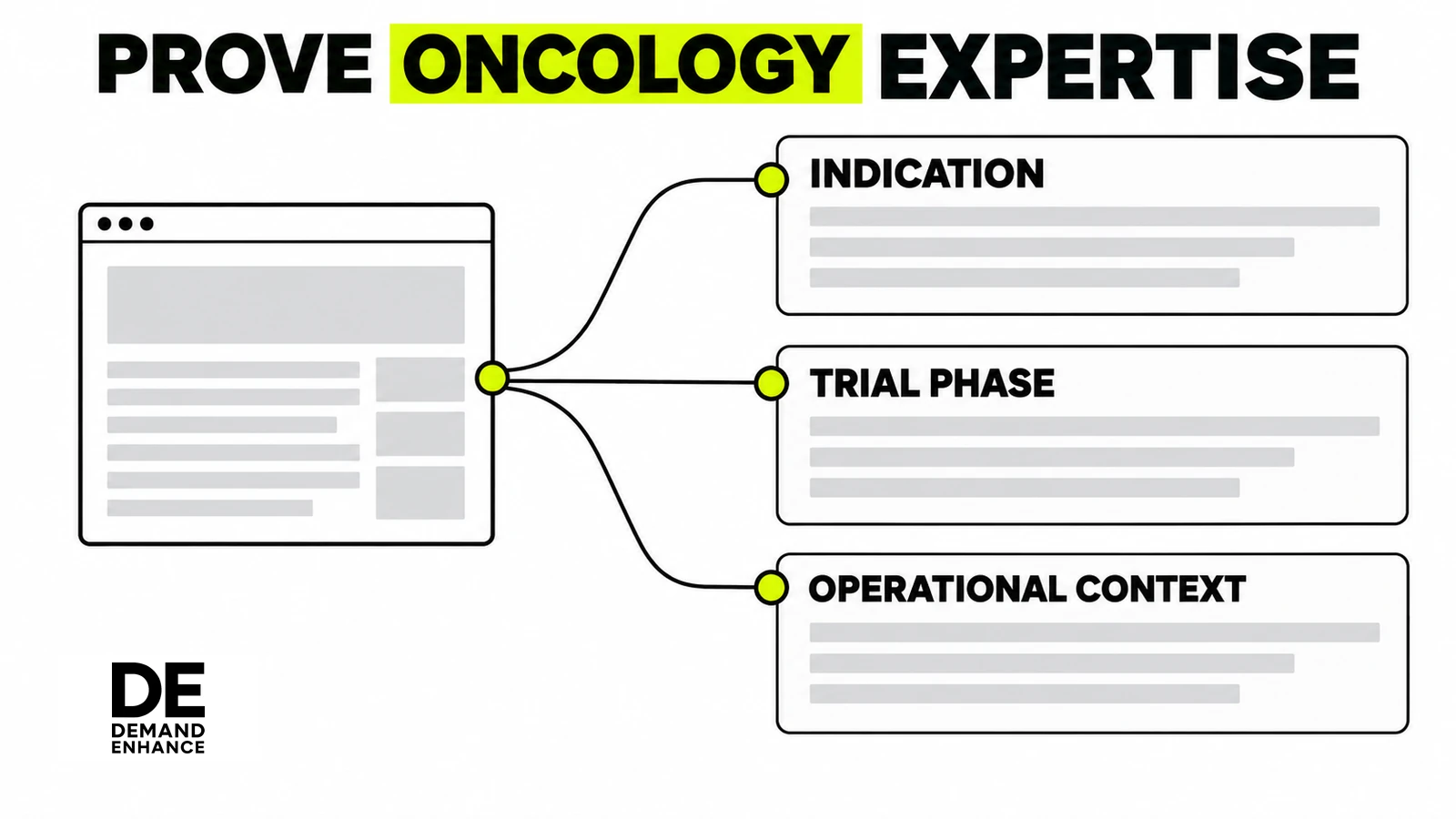
The same applies to rare disease, CNS, immunology, dermatology, women’s health, cardiovascular research, or any other area where the CRO wants to be perceived as credible.
This matters because AI search often favors specific, answerable expertise.
A sponsor may ask:
“What should an emerging biotech company look for in a CRO for a Phase II rare disease trial?”
To be surfaced or referenced in that type of answer, your website needs more than a rare disease bullet point. It needs content that connects rare disease expertise to biotech sponsors, Phase II studies, feasibility, recruitment, patient identification, retention, and operational delivery.
This is where many CROs have a major opportunity.
Their real-world expertise is often much deeper than their website suggests. The problem is that the website does not expose that expertise clearly enough.
AI search rewards clear relationships
Traditional SEO often focused on pages and keywords.
AI search is more relationship-driven.
It tries to understand how entities connect.
A CRO is not just a company. It is connected to services, therapeutic areas, study phases, geographies, regulatory environments, sponsor types, experts, case studies, outcomes, and operational capabilities.
If your website makes those relationships clear, it becomes easier to understand.
That is why internal linking and content architecture matter so much.
An oncology CRO page should not sit alone. It should connect to oncology recruitment content, feasibility resources, relevant case studies, expert profiles, biotech sponsor pages, and related service pages.
The goal is not to build a random blog archive.
The goal is to build a knowledge structure.
A CRO with ten specific, connected, evidence-rich pages around oncology trials may send a stronger authority signal than a CRO with fifty generic blog posts about clinical research trends.
This is one of the biggest SEO mistakes in the sector: content volume is mistaken for topical authority.
They are not the same thing.
Topical authority comes from depth, clarity, internal relationships, and proof.
Your experts should not be invisible
Clinical research is a trust-heavy industry.
Sponsors are not buying a simple service. They are choosing a partner that may influence timelines, data quality, recruitment performance, regulatory readiness, and ultimately the success of a study.
That means expertise needs to be attributable.
Many CRO websites talk about “experienced teams,” but hide the people behind the work. From an AI search and trust perspective, that is a problem.
If your organization has clinical operations leaders, therapeutic area specialists, regulatory experts, recruitment strategists, medical directors, data managers, or biostatisticians, their expertise should be visible where it matters.
This does not mean turning every team member into a public thought leader.
It means connecting key people to key areas of expertise.
An oncology operations expert should appear on oncology-related content. A regulatory specialist should be connected to regulatory strategy pages. A recruitment lead should be associated with patient recruitment resources. Expert profiles should show relevant experience, credentials, therapeutic focus, study phase experience, and content contributions.
This makes the company’s claims more credible.
It also gives search engines and AI systems clearer evidence that the expertise on the website is connected to real professionals, not anonymous marketing copy.
Case studies need to become easier to extract
Case studies are among the strongest trust assets a CRO can publish, but many are too vague to support AI search effectively.
A typical CRO case study might say:
“We helped a biotech sponsor accelerate recruitment through a patient-centric strategy.”
That sounds positive, but it lacks useful detail.
What type of sponsor was it? What phase? What therapeutic area? What geography? What was the operational challenge? What did the CRO actually do? What can another sponsor learn from it?
Confidentiality is a genuine limitation in clinical research, but it is not an excuse for empty case studies. You can anonymize the sponsor and still provide meaningful structure.
A stronger case study might explain that an emerging biotech sponsor preparing a Phase II rare disease trial needed support with feasibility and recruitment planning across selected European markets. The challenge involved a small patient population, uneven site experience, and uncertainty around referral pathways. The CRO supported country feasibility, site profile development, recruitment pathway analysis, and operational planning.
That version is far more valuable.
It gives AI systems and human buyers specific signals: sponsor type, phase, therapeutic area, geography, challenge, and CRO role.
The best case studies also include a section explaining what similar sponsors can learn from the project. That turns proof into decision-support content.
The homepage needs sharper positioning
AI search also exposes weak positioning.
Many CRO homepages try to be everything to everyone. They claim global reach, full-service capabilities, broad therapeutic expertise, flexible models, innovation, and quality.
The problem is that this often makes the company harder to categorize.
AI systems are more likely to recommend a company when the fit is clear.
A CRO that says it supports “clinical research across multiple therapeutic areas” is less memorable than one that clearly states it is best suited for emerging biotech sponsors running early-phase oncology and rare disease studies.
This does not mean every CRO must artificially narrow its business.
It means the website should make the strongest fit obvious.
Who are you genuinely best for?
Emerging biotech companies? Mid-sized pharma? Sponsors with complex recruitment needs? Early-phase studies? Rare disease trials? Oncology programs? Multi-country European studies? Functional service support rather than full-service delivery?
The answer should be visible on the homepage and reinforced across the site.
A clear “best fit for” section can do more for positioning than another generic paragraph about innovation.
Blog content should move closer to sponsor intent
Many CRO blogs are educational, but too basic.
Topics like “What is clinical research?” or “Why patient recruitment matters” may attract traffic, but they often do not reflect how serious sponsors evaluate vendors.
AI search optimization should move CRO content closer to decision-stage questions.
Instead of publishing broad articles, CROs should answer the questions sponsors actually ask before choosing a partner:
How do you choose a CRO for a Phase II oncology trial?
What should biotech sponsors ask before selecting a clinical research partner?
Why does site feasibility fail in rare disease trials?
When should a CRO be involved before protocol finalization?
What makes decentralized trial experience credible?
How should sponsors evaluate patient recruitment capabilities?
This type of content has two advantages.
It is more useful to real buyers, and it is more likely to match AI-generated answers because it addresses complex, high-intent questions directly.
The goal is not to publish more.
The goal is to publish closer to buying logic.
Structured data helps, but it will not rescue weak content
Schema markup, FAQ markup, article schema, organization schema, person schema, and breadcrumbs can all support AI search visibility. They help search engines interpret a page more clearly.
But structured data is not a magic fix.
If your content is vague, schema will only structure the vagueness.
A CRO should absolutely implement appropriate schema, especially for organization details, expert profiles, articles, FAQs, breadcrumbs, and case study-style content where relevant.
But the markup should reflect strong visible content.
It should support the evidence layer, not replace it.
The priority is still the page itself: clear claims, clear proof, clear relationships, and clear expertise.
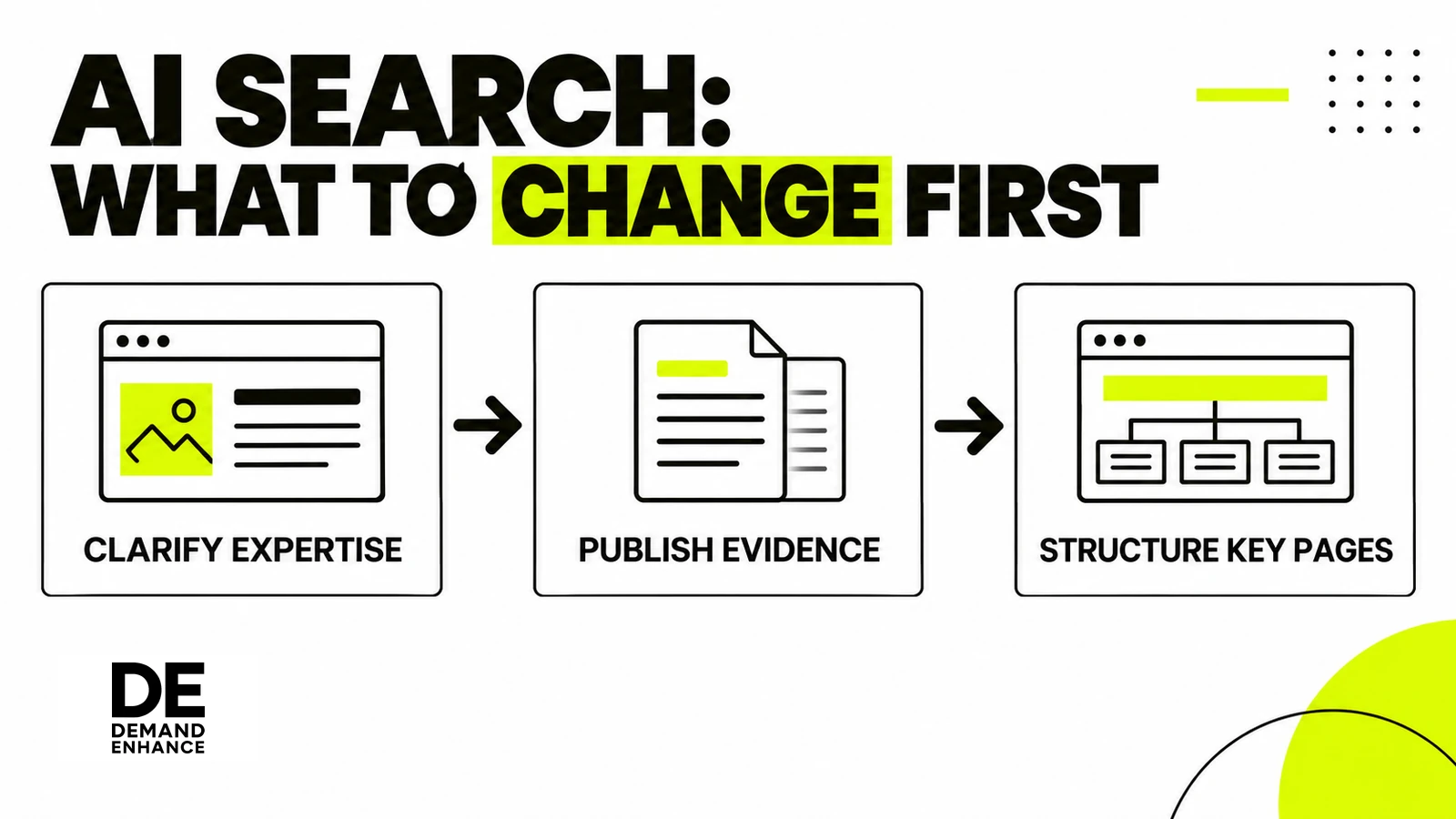
What CROs should change first
The first wave of AI search optimization should focus on the pages that most directly influence understanding and trust.
Start with the homepage, because that is where positioning is established. Make it immediately clear who the CRO serves, what it specializes in, which study types it supports, and where its strongest evidence sits.
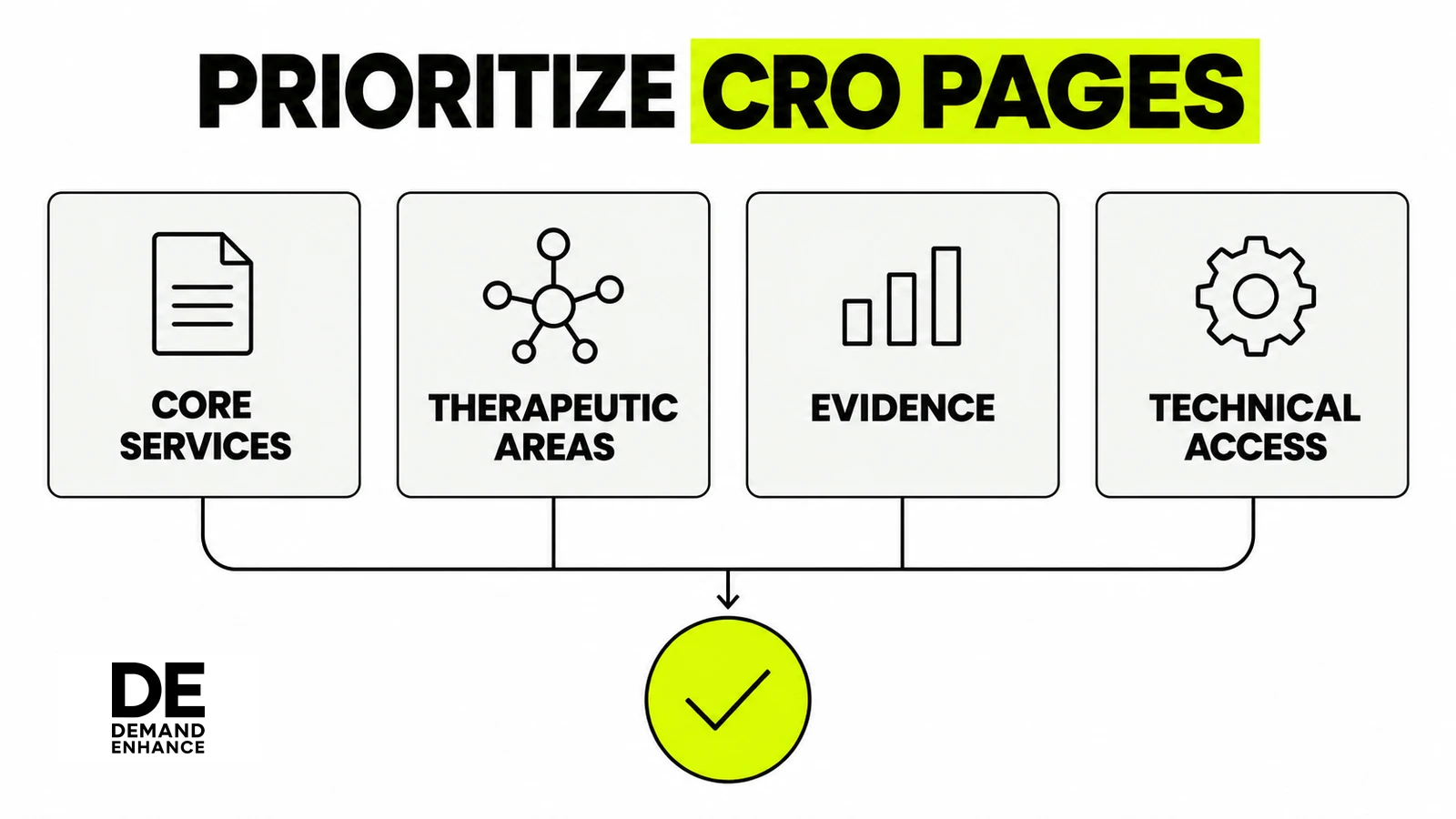
Then improve the core service pages. Rewrite them around sponsor decision-making rather than internal service descriptions. Add context, use cases, fit, risks, process, and proof.
Next, build or strengthen therapeutic area pages. These should not be thin landing pages. They should show practical knowledge of study complexity, recruitment challenges, operational requirements, and sponsor concerns.
After that, connect everything with case studies, expert profiles, and internal links. This is where your CRO Evidence Layer becomes visible.
Only then should you move into more advanced AI-specific enhancements, such as expanded schema, answer-style summaries, AI-ready FAQ blocks, and experimental generative search features.
The order matters.
If you add AI features before fixing content clarity, you are scaling confusion.
The most valuable SEO insight for CROs
The biggest opportunity for CROs is not “AI content.”
It is AI-readable expertise.
There is a major difference.
AI content usually means producing more articles with AI tools.
AI-readable expertise means structuring real clinical, scientific, and operational knowledge so that search engines, AI systems, and sponsors can understand it.
That is where CROs can separate themselves from generic competitors.
A CRO with deep oncology experience should not let that experience remain buried in proposals, pitch decks, internal documents, and sales conversations. It should be translated into public-facing content that explains how oncology trials actually work, where sponsors struggle, what operational mistakes create risk, and how the CRO helps solve those problems.
A CRO with rare disease experience should not simply list rare disease as a therapeutic area. It should show how rare disease recruitment, site selection, advocacy relationships, patient identification, and retention differ from more common indications.
A CRO with decentralized trial experience should not just say it is innovative. It should explain when decentralized elements help, when they add complexity, and how sponsors should evaluate whether a decentralized model is appropriate.
This is what AI search is likely to reward: not marketing volume, but structured expertise.
The future of CRO SEO is recommendation eligibility
Traditional SEO asks:
“Can this page rank?”
AI search optimization asks a harder question:
“Is this company eligible to be recommended for this sponsor’s problem?”
That is the right frame.
To become recommendation-eligible, a CRO website must show specificity, relevance, and proof. It must make clear what the company does, who it serves, where it has experience, and why a sponsor should trust it.
That requires more than keywords.
It requires stronger positioning. Better information architecture. More useful service pages. Deeper therapeutic area content. More structured case studies. Clearer expert visibility. Smarter internal linking. Better answers to real sponsor questions.
In other words, AI search optimization is not just an SEO project.
It is a trust-building project.
Final takeaway
CROs should not respond to AI search by rushing into generic content production or technical gimmicks.
The first move is simpler and more important:
Make the website easier to understand.
Clarify what you specialize in. Connect services to therapeutic areas and study phases. Show where your expertise applies. Make your experts visible. Turn case studies into structured proof. Build pages that help sponsors make decisions, not just pages that describe what you sell.
The CROs that do this first will have a serious advantage.
Because in AI search, visibility will increasingly depend on whether your company can be understood, trusted, and confidently recommended.
And that starts with a website that proves expertise instead of merely claiming it.
At Demand Enchance, we help CROs, biotech companies, pharma SaaS platforms, and life science organizations turn their websites into authority-building growth assets.
If your website explains what you do but does not clearly prove why sponsors should trust you, AI search will expose that weakness quickly.
The opportunity is to fix it before your competitors do — by turning your clinical expertise, therapeutic knowledge, and operational experience into a search-ready structure that Google, AI tools, and qualified buyers can understand.
Frequently asked questions
What should a CRO improve before adding more schema markup?
Clarify who the company serves, what each page covers, and what evidence supports its claims. Make authorship and relationships between services, study contexts, and resources visible first; markup should accurately describe that content.
How can a CRO service page demonstrate relevance to a sponsor?
Explain the service scope, study contexts, sponsor needs, and relevant operational approach in language the organization can substantiate. Connect the page to credible evidence, expert profiles, or related resources instead of relying on broad capability statements.
How can a CRO make a useful case study when client details are confidential?
Share only information approved for disclosure, and anonymize details where appropriate. A useful account can still describe the context, challenge, approach, and transferable lesson, while omitting identities or outcome figures that cannot be published responsibly.
Sources and further reading
Demand Enhance
Strengthen the evidence layer on key pages
Select one service page and a related proof asset for a working review with Demand Enhance. Assess whether sponsors can understand the fit, supporting evidence, and next relevant resource without relying on unsupported claims.
Discuss your priorities