
AI DISCOVERY / ANSWERS & CITATIONS
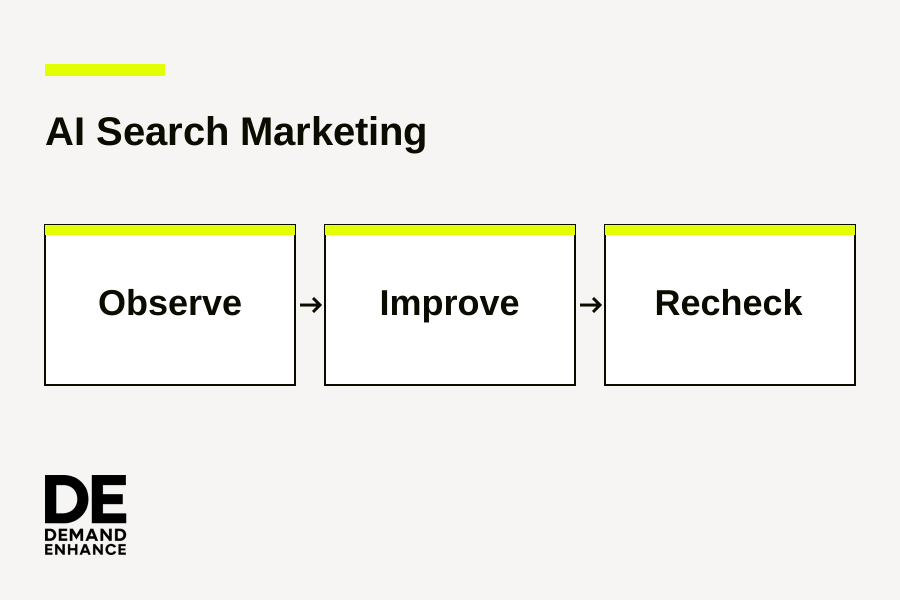
AI search marketing for life sciences
See how AI-assisted discovery describes your company, which sources it uses and whether buyers can verify the capabilities behind the answer.
For biotech and pharma commercial teams, contract research organizations (CROs) and CDMOs explaining specialist services, platforms or technical capabilities to business buyers.
01 / Sample
Choose the questions buyers ask
Define a documented query sample around your service lines, applications and the comparisons your sales team hears.
02 / Diagnose
Inspect answers and cited evidence
Record observed mentions, capability descriptions and cited URLs, with the platform, market and review date.
03 / Improve
Make the supporting record easier to assess
Prioritize accurate capability content and credible sources, with client expert review and practical ownership.
When an AI Search review is useful
This service is for specialist B2B offers that can be difficult to summarize in a short answer. It helps a marketing or commercial team inspect a defined set of AI-assisted discovery results and decide where better evidence could support a buyer's evaluation.

Your capabilities need more context
A short answer may flatten distinctions between a drug modality, research platform, therapeutic focus, study phase or manufacturing process. Review whether sampled answers connect the right capability to the right company and buyer need.
Buyers compare providers before contacting sales
A sponsor assessing a CRO may ask about therapeutic experience, trial phases, geographies or delivery model. A biotech partner may investigate a platform or application; a pharma or CDMO buyer may compare scale, modalities or technology-transfer capabilities. Define the questions around your actual offer.
You need an inspectable baseline
A dated sample makes a broad question such as “Are we visible in AI?” more actionable. It records observed mentions, descriptions and citations, then separates those diagnostics from referral visits and qualified commercial outcomes.
What AI Search Marketing covers
The scope is the answer layer: a defined set of buyer questions, the way selected AI discovery environments respond, and the source evidence behind those responses. It complements SEO & GEO, which establishes the technical and organic-search foundation.

Buyer-question and platform sampling
Agree the service lines, buyer roles, markets, languages and discovery environments to review. Questions can cover how sponsors compare CRO study services, how a biotech buyer evaluates a platform application, or how a pharma team assesses a CDMO capability. Record the wording and conditions so the sample can be inspected and repeated. It is a diagnostic sample, not a census of searches or buyers.
Capability and brand representation
For each answer, record whether the company is mentioned and what it is associated with. Check for missing context or confusion between business units, technologies, therapeutic areas, study services, manufacturing capabilities or similarly named organizations. Route scientific and technical statements to your qualified reviewers; findings describe the sampled outputs only.
Citation and source analysis
Log cited URLs and classify them as company-owned or independent sources, such as specialist publications, associations, partner profiles or other relevant pages. Assess whether a source is accessible, current, specific and consistent with approved facts. Where relevant, check whether search crawlers such as OAI-SearchBot can access public source pages; search access is distinct from training-crawl controls and does not guarantee citations. A citation is an observed source, not an endorsement, ranking position or evidence that a buyer trusts the claim.
Evidence-gap recommendations
Turn material gaps into a prioritized plan: clarify a service or capability page, answer a technical buyer question, explain a comparison criterion, align company facts or update an appropriate profile. Your subject-matter experts validate scientific content and authorized reviewers approve sensitive statements. Independent editorial coverage remains with its publisher; the service can identify relevant evidence opportunities but cannot control inclusion.
A repeatable review for a changing answer layer
Each review preserves the questions, observations and conditions that explain what was checked. This gives a team a useful comparison point without treating AI outputs as stable search rankings.
01 / Define the commercial scope
Select priority offers, buyer roles, markets and platforms. Agree what counts as an accurate capability description, a relevant mention, a citation and a qualified action. Confirm the approved source material and who reviews technical claims.
02 / Capture the dated sample
Run the agreed questions and record answers, cited pages, mention status and notable inaccuracies. Keep wording and review conditions with the record; outputs can vary by query, location, time and platform changes.
03 / Trace the supporting evidence
Review relevant owned pages and cited sources for clarity, access, recency and factual support. Separate a website-content issue from an external-source issue, and assign scientific or technical review to the appropriate client expert.
04 / Prioritize and recheck
Recommend actions against buyer importance, evidence quality and practical ownership. Agree which changes can be measured, repeat the sample at a suitable interval and explain differences with dates and limitations.
Separate answer observations from commercial outcomes
There is no universal cross-platform AI visibility metric. Reports should show the sample and its denominator, distinguish platform-specific measures and connect downstream activity only when the underlying data supports it.
Representation within the sample
Track mentions, capability accuracy, cited URLs and source types across the agreed questions, platform and review date. Show how many prompts were checked and the conditions used; results describe that sample only.
Identifiable referrals
Where analytics access and tagging permit, review visits attributed to AI-search sources, including ChatGPT referrals. Google Search Console documents impressions from its AI Overviews and AI Mode report. These signals cover defined reporting surfaces and do not reveal every answer or establish buyer intent.
Qualified actions where data permits
If consent, identifiers, analytics and CRM records support a reliable connection, review relevant inquiries, accepted leads or opportunity progression. A citation, click, session or form submission is not automatically a qualified lead, and an attribution model does not prove causation.
Prompt samples are directional, not market research. No-click discovery, untagged visits and activity without a reliable analytics-to-CRM connection may remain unmeasured.
How AI Search fits with SEO & GEO
SEO & GEO builds the durable search foundation: technical access, information architecture, useful capability content and conventional organic measurement. AI Search Marketing adds a dated review of selected buyer questions, answer representation and citation sources. Reputation & Authority can address relevant independent-source and expert-visibility opportunities identified in that review. Shared evidence may inform both services, but the deliverables differ: site and organic-search improvement versus sampled answer and source diagnostics.
Explore related guidance
These existing Demand Enhance resources offer practical context for CRO teams and life-sciences content owners.
AI search optimization for CRO websites
A CRO-focused guide to the website information worth reviewing first for AI-assisted discovery.
Structuring life-science content for search
How clear page structure can help people and search systems understand specialist expertise.
Questions about AI Search Marketing
The questions below clarify how this diagnostic service fits a technical B2B buying process and what it can reasonably establish.
How do you approach AI search optimization for a biotech or pharma business?
Start with the company's actual capabilities and the questions its commercial team hears. Agree a sample and review conditions, record brand descriptions and cited URLs, then prioritize gaps in accessible, approved evidence. Client experts review technical claims. SEO & GEO supplies the website foundation; this service adds answer and source diagnostics. Repeat observations can show patterns, but they are not stable rankings or a guarantee of citations.
Can you guarantee that ChatGPT or Google AI will cite our company?
No. Platforms choose what to show, and answers can change with the question, market, time and system. The work can identify access and evidence gaps and recommend improvements to accurate, useful information. It cannot guarantee a mention, citation, placement or qualified inquiry.
How do you choose questions for biotech, pharma, CRO or CDMO teams?
We define them from the offer and the decisions buyers need to make. Depending on the business, a sample might examine sponsor questions about a CRO's therapeutic or study experience, biotech questions about a platform's applications, or pharma questions about CDMO modalities, scale and technology transfer. The final wording is agreed with your commercial team and technical reviewers; it is not presented as a representative buyer survey.
What if an answer misstates a scientific capability or cites an outdated page?
The review records the wording, cited URL and date, then checks the source against information your team has approved. A practical response may be to clarify the owned capability page or contact an external publisher about a factual issue. Scientific claims need your qualified review, and neither a correction nor removal can be promised.
Do we need special AI schema or files to appear in Google AI results?
Google's Search guidance says its existing Search fundamentals apply to AI Overviews and AI Mode and does not require separate AI files or special markup for eligibility. We check current platform guidance and core access issues before recommending technical changes. Eligibility does not guarantee that a page or company will appear.
How can we tell whether AI discovery contributes to qualified demand?
Start with a dated answer and citation sample. Add identifiable referral sessions where analytics supports them, then assess qualified inquiries or opportunities only when analytics and CRM records can be connected under an agreed definition. Google AI-feature impressions and ChatGPT referral visits are useful diagnostics; neither alone proves buyer fit, pipeline contribution or causation.
Make complex capabilities easier to understand
Bring a priority service line, platform or market. We can define a focused question sample, inspect how AI answers represent your capabilities and identify which evidence deserves attention next.
Discuss an AI-search reviewThe review reports observed answers and sources; independent platforms decide whether they mention or cite a company. This site is protected by reCAPTCHA and the Google Privacy Policy and Terms of Service apply.