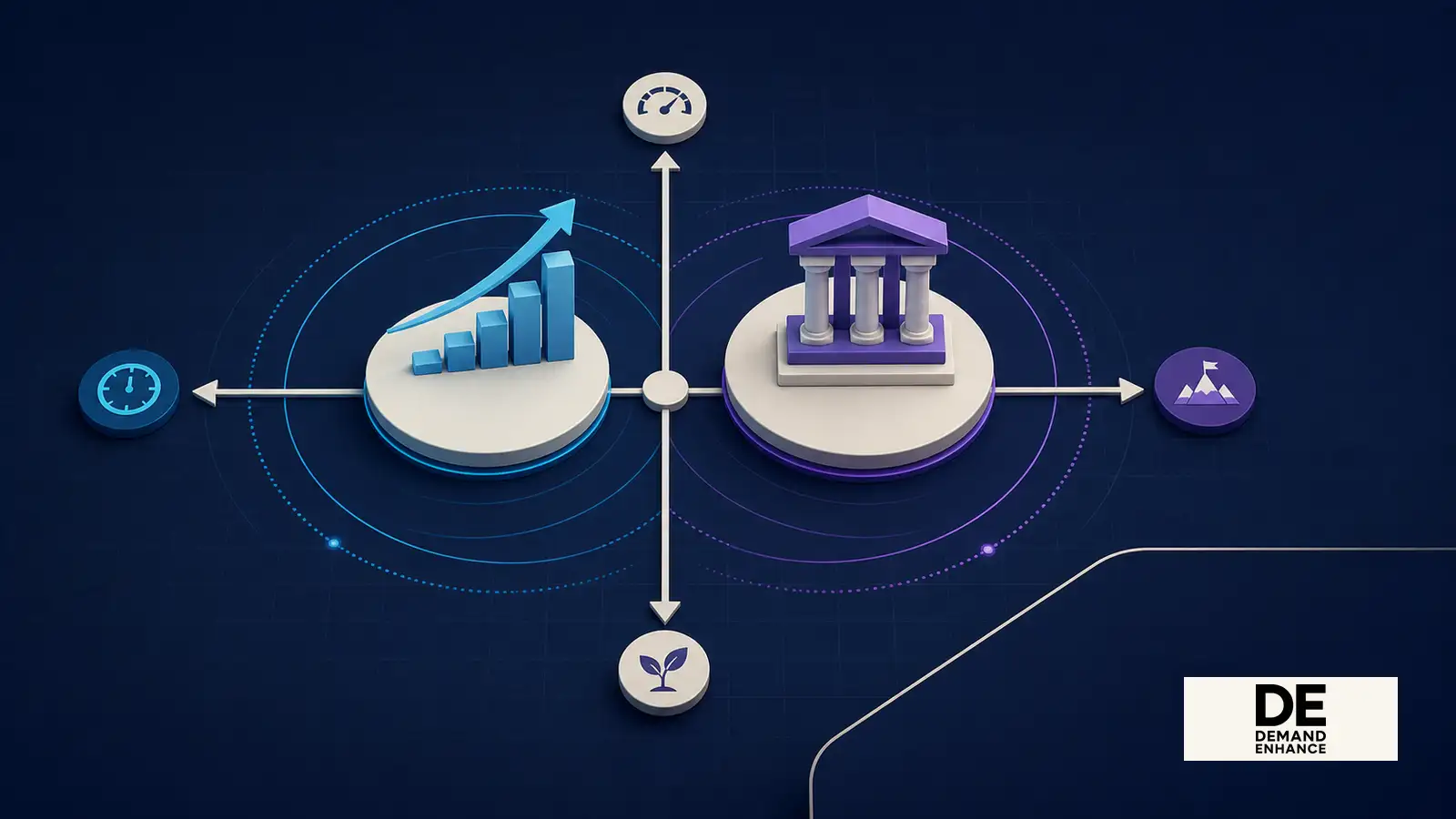
The SEO vs PPC debate is one of the most common strategic questions in life science marketing, and it is almost always framed incorrectly. The real question is not ‘which channel is better’ but ‘which channel fits where we are, what we are trying to achieve, and what our commercial timeline looks like.’
For CROs, CDMOs, and biotech vendors, the answer is nuanced. SEO and PPC have genuinely different strengths, different risk profiles, and different payback timelines. The right allocation depends on your growth stage, your sales cycle, your competitive position, and the specific search landscape in your service area.
This guide provides a structured framework for making that allocation decision — not a generic recommendation, but a set of diagnostic questions and decision rules that will help you reach the right answer for your specific situation.
The Fundamental Difference Between SEO and PPC in Life Science
SEO and PPC are both search-based channels, but they operate on completely different economic models.
PPC gives you immediate visibility at a cost that is proportional to your budget. You can be on page one of Google tomorrow if you are willing to pay for it. But the moment you stop paying, you disappear. In life science, where sponsored links for service-adjacent terms can cost between GBP 8 and GBP 40 per click, PPC can be an efficient channel for specific high-intent terms — but it is expensive to maintain as a primary discovery channel.
SEO builds organic visibility over time. The investment is front-loaded — you are paying for content creation, technical optimisation, and link building before you see any rankings — but the resulting visibility does not disappear when you stop investing. A well-built life science SEO programme will continue to generate traffic and leads for years after the initial investment.
When PPC Is the Right First Investment
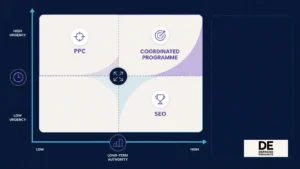
PPC should generally be the first investment in the following scenarios.
You need leads within 90 days
If your commercial timeline requires qualified leads within the next quarter, SEO cannot deliver that. Organic rankings for competitive life science terms can take six to twelve months to achieve. PPC can generate qualified clicks immediately.
You are entering a new service area or geography
If you are launching a new service line or expanding into a new market, PPC allows you to test demand and refine your messaging quickly before committing to a long-term SEO content programme.
You are targeting a very small, high-value audience
For some life science service providers, the addressable sponsor audience is very small — perhaps a few hundred relevant decision-makers globally. In that case, the economics of PPC can work in your favour: the cost per click is less important than the ability to reach a precisely defined audience at exactly the moment they are searching.
When SEO Is the Right First Investment
SEO should generally be the first investment in the following scenarios.
Your sales cycle is longer than six months
In long sales cycles, sponsors need multiple touchpoints before they are ready to engage. SEO builds the trust and familiarity that make those touchpoints possible. A sponsor who has read three of your blog articles before they begin their vendor evaluation is already predisposed to shortlist you — a PPC ad on its own cannot create that relationship.
Your service area has strong informational search demand
If sponsors in your space are actively searching for guidance, frameworks, and problem-solving content — which is true for most CRO and CDMO service areas — a content-led SEO programme can intercept those buyers early and build authority before the RFP stage.
You are building a long-term brand in your niche
If your strategic goal is to become the recognised authority in your service niche — preclinical oncology, sterile manufacturing, rare disease trials — SEO is the channel that builds that authority over time. PPC can buy you clicks but it cannot buy you credibility.
The Case for Running Both Simultaneously
In most cases, the most effective approach for a life science vendor with a meaningful marketing budget is to run SEO and PPC in parallel — but with different objectives.
PPC should be used to capture immediate demand: high-intent service category terms where sponsors are actively evaluating vendors, retargeting campaigns for visitors who have engaged with your content but not converted, and geographic or indication-specific campaigns for specific business development targets.
SEO should be used to build long-term pipeline: problem-aware content that intercepts sponsors early in their journey, authority content that builds trust over multiple visits, and service pages optimised for mid-to-long-tail queries that PPC cannot efficiently cover.
When the two channels are integrated — PPC targeting visitors who arrived via SEO, SEO content informed by PPC keyword performance data — the combined effect is significantly greater than either channel alone.
Budget Allocation Framework
For life science vendors allocating digital marketing budget for the first time, a practical starting framework is the 60/40 rule: 60% to SEO and content, 40% to PPC. This weighting reflects the long-term value of SEO investment and the immediate demand-capture role of PPC.
Adjust this based on your situation:
- If you need immediate leads and have budget: shift to 40% SEO / 60% PPC short-term, then rebalance as SEO matures
- If you are a well-funded startup with no organic presence: consider 30% SEO / 70% PPC for the first six months, then shift toward SEO as content builds
- If you are an established vendor with existing organic traffic: shift toward 70% SEO / 30% PPC maintenance, using PPC only for specific high-intent terms
The Role of LinkedIn in the Life Science Channel Mix
For CROs and CDMOs, LinkedIn deserves a specific mention. LinkedIn Ads is not a search channel — it is an audience channel. It targets people based on who they are (title, company, industry, seniority) rather than what they are searching for. In life science, where the buyer audience is small and specific, this makes LinkedIn a powerful complement to both SEO and PPC.
LinkedIn works best as a retargeting and brand awareness channel: reaching people who have already visited your website, showing content to precisely defined audience segments (biotech directors, clinical operations VPs, process development leads), and supporting the longer relationship-building that life science sales cycles require.
We cover the integration of SEO, PPC, and LinkedIn in detail in a separate guide. For now, the key point is that LinkedIn amplifies the content you are building for SEO — showing it to a targeted audience that is less likely to find it through organic search alone.
Making the Decision for Your Organisation
Use these questions to guide your allocation decision:
- What is your current organic traffic level? If it is near zero, you have no SEO foundation — PPC can bridge the gap while SEO is built.
- What is your lead timeline requirement? If you need pipeline within 90 days, PPC must be part of the mix.
- What is your average sales cycle? The longer the cycle, the more valuable SEO content investment becomes.
- What is your competitive position in organic search? If competitors have strong content programmes and you do not, closing that gap is urgent.
- Do you have the content capability to execute SEO? PPC can start with a landing page. SEO requires sustained, quality content output.
Next Steps
The SEO vs PPC decision is not permanent. Most life science vendors who start with PPC for immediate demand will gradually shift toward SEO as their content programme builds and their organic traffic grows. The key is to start with the right balance for where you are now and to have a plan for where you want to be in 12 and 24 months.
Request a marketing channel audit from DemandEnhance. We will assess your current organic position, competitive landscape, and lead timeline requirements to produce a channel allocation recommendation specific to your business.