CRO and CDMO are two of the most commonly confused acronyms in life science marketing. They are both B2B service providers in the pharmaceutical and biotech space. They are both evaluated by sophisticated technical buyers on long sales cycles. And they both operate in a world where a small number of high-value relationships matter far more than broad brand awareness.
CRO vs CDMO Marketing: Why the Same SEO Strategy Does Not Work for Both
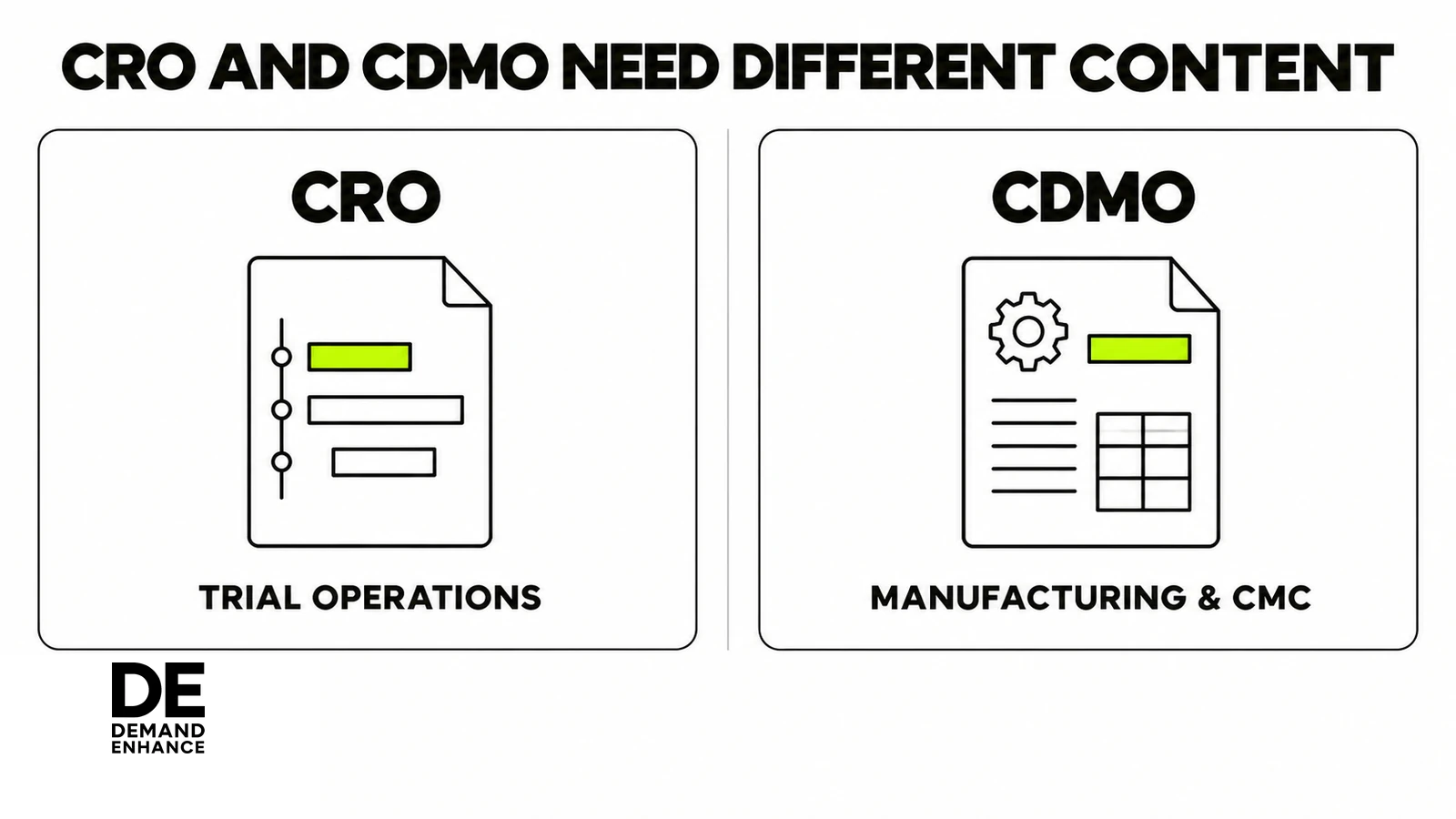
So it is tempting to assume that the same SEO and content marketing strategy works for both. It does not — and understanding why is one of the most important strategic decisions a life science marketing director will make.
This guide explains the fundamental differences between CRO and CDMO buyer behaviour, search intent, content needs, and conversion architecture, and shows why a strategy built for one will systematically underperform for the other.
The Core Difference: What the Buyer Is Evaluating
The deepest strategic difference between CRO and CDMO marketing is what the buyer is ultimately evaluating.
A sponsor evaluating a CRO is evaluating operational trust: can this organisation run a complex clinical trial, manage a global site network, navigate regulatory variability, and deliver to a programme timeline that is directly tied to their drug approval pathway? The risk they are managing is execution risk across a long, multi-site, multi-stakeholder programme.
A technical buyer evaluating a CDMO is evaluating manufacturing capability and regulatory continuity: can this organisation manufacture my molecule at scale, to specification, with a consistent quality system, and support the CMC package that my drug approval depends on? The risk they are managing is quality risk and supply chain risk — failure modes with direct regulatory consequences.
Same industry. Very different buyer psychology. Very different content needs.
Buyer Journey Differences
CRO buyer journey
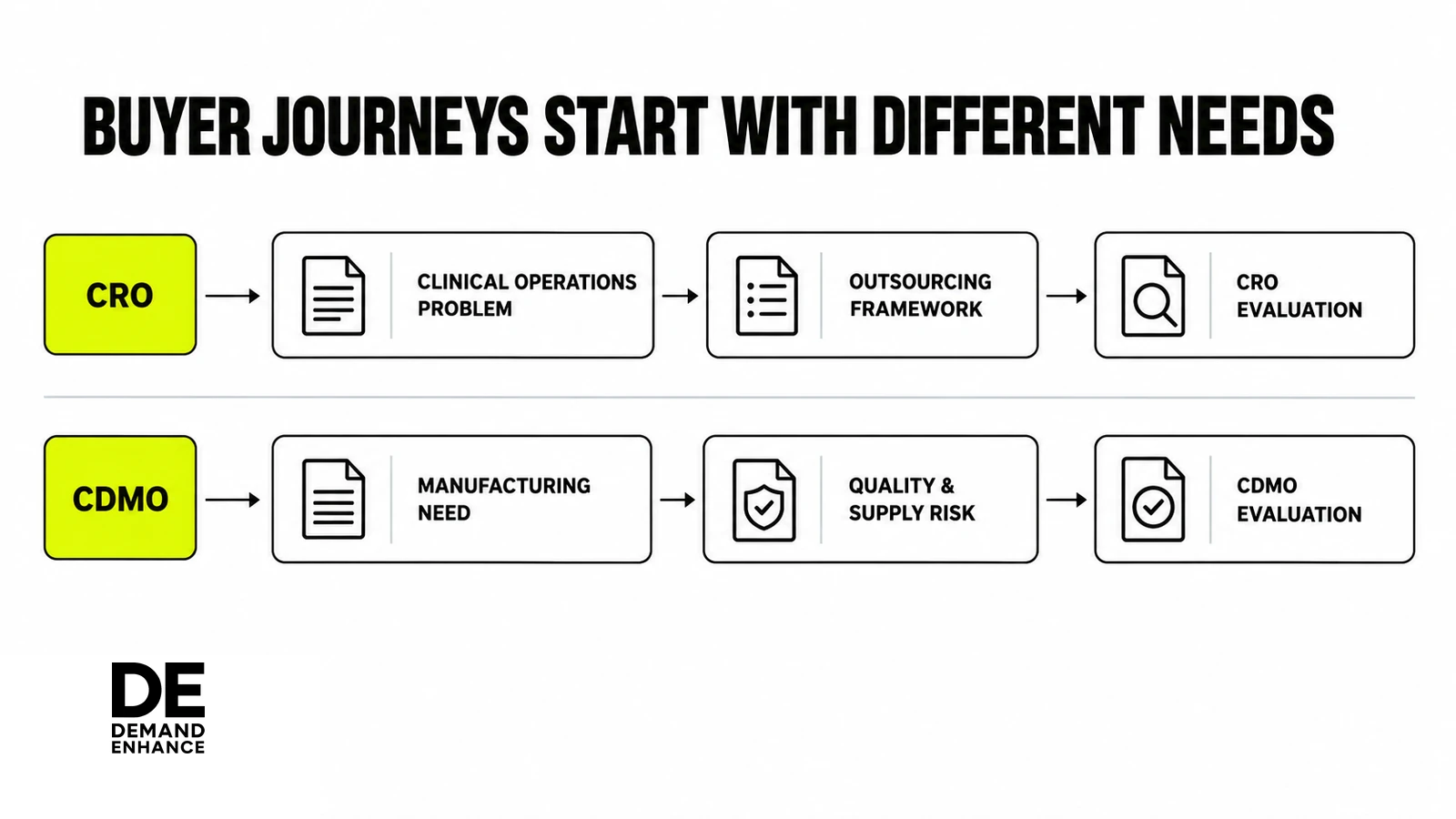
The CRO buyer journey is often initiated by a clinical operations problem. The sponsor has a trial to run and is evaluating whether to build capacity in-house or outsource. Their search behaviour is problem-led: they search for operational challenges, outsourcing decision frameworks, and phase-specific guidance before they begin evaluating specific CROs.
The decision is often made by a cross-functional team — clinical operations, regulatory affairs, finance — and the evaluation criteria include therapeutic area experience, site network quality, regulatory track record, and communication model.
CDMO buyer journey
The CDMO buyer journey is often initiated by a manufacturing milestone: an IND filing, a Phase II technology transfer, a commercial scale-up requirement. The buyer is typically a formulation scientist, a process development lead, or a CMC regulatory director. Their search behaviour is technically specific: they search for dosage form capabilities, API characteristics, scale-up methodologies, and regulatory submission experience.
The decision is often made by a smaller, more technically focused team, and the evaluation criteria are dominated by manufacturing capability evidence: batch records, analytical method packages, technology transfer history, and quality system documentation.
Search Intent Differences
The search intent differences between CRO and CDMO buyers are significant enough to require completely different keyword strategies.
Plan for CRO and CDMO audiences
Applying Agentic SEO may help dual-service providers draft distinct topic groupings for clinical operations and CMC manufacturing inquiries. After a positioning audit, marketing owners should validate each group against actual services, buyer language, and available evidence before publication; segmentation suggestions do not guarantee a clear distinction between buyer groups.
- Document each buyer group's trigger, questions, technical vocabulary, and decision criteria using customer and internal team input.
- Map CRO and CDMO queries to distinct topic clusters and page formats that reflect their different service and evidence needs.
- Choose proof and next steps appropriate to each audience, then cross-link only where the relationship helps the reader.
Put the idea into practice
Choose a content architecture
A company offers both CRO and CDMO services; how should it structure buyer-facing content?
Use one shared journey
Use a shared journey for resources that genuinely address a common question or company-level topic. When buyer vocabulary and proof differ, keep service paths distinct and assign clear page ownership so each audience can find relevant evidence.
Create distinct buyer paths
Choose this when CRO and CDMO buyers need different information and evidence. Build clear topic paths for each service, share brand standards and technical foundations, and connect the paths only where the relationship is useful.
Separate the buyer paths
Define each buyer
Identify the CRO sponsor roles and CDMO technical roles the organization serves, then document their distinct triggers, questions, risks, and decision contexts using customer insight.
Map search intent
Group each audience vocabulary, capability queries, process questions, and evaluation needs; assign page types that answer those needs directly without blending distinct buyer priorities or evidence needs.
Connect relevant proof
Select evidence and next steps for each path, preserving clear service context and linking across paths only when a shared resource genuinely helps the buyer.
Select a step to explore the idea.
CRO search intent patterns
- Problem-led queries: ‘managing CRO delays’, ‘Phase II site activation timeline’, ‘clinical trial vendor oversight‘
- Comparison queries: ‘full-service CRO vs FSP’, ‘CRO selection criteria’, ‘how to evaluate a CRO’
- Operational process queries: ‘CRO RFP template’, ‘clinical trial feasibility assessment’, ‘Phase I study startup checklist’
- Therapeutic area queries: ‘oncology CRO experience’, ‘rare disease clinical trial partner’, ‘CNS Phase II CRO’
CDMO search intent patterns
- Capability queries: ‘sterile fill-finish CDMO’, ‘oral solid dosage form manufacturer’, ‘biologics CDMO mAb’
- Process queries: ‘technology transfer CDMO’, ‘API scale-up manufacturing’, ‘process validation pharmaceutical’
- Regulatory queries: ‘CDMO FDA inspection history’, ‘cGMP manufacturing partner’, ‘CMC regulatory support CDMO’
- Capacity and geography queries: ‘contract manufacturer Europe’, ‘US CDMO solid dose’, ‘small batch clinical manufacturing’
The vocabulary is almost entirely different. A content strategy optimised for CRO search terms will rank for almost nothing a CDMO technical buyer searches for, and vice versa.
Content Architecture Differences
CRO content architecture
A CRO content hub should be organised around the sponsor journey: problem awareness, solution exploration, vendor evaluation, and engagement confirmation. The pillar content should address operational challenges and outsourcing decisions. Service pages should be organised by phase and therapeutic area. Case studies should focus on programme delivery outcomes.
CDMO content architecture
A CDMO content hub should be organised around manufacturing capability and the drug development lifecycle: early development manufacturing, clinical manufacturing, commercial scale-up, and regulatory support. The pillar content should address manufacturing challenges and technology transfer decisions. Service pages should be organised by dosage form and molecule type. Case studies should focus on manufacturing outcomes: yield, timeline, batch success rate, regulatory submission outcome.
Attempting to use a single content architecture for both CRO and CDMO services — which some dual-service organisations do — typically produces content that is too generic to rank well for either audience.
Trust Signal Differences
What builds trust with a CRO buyer is different from what builds trust with a CDMO buyer.
CRO buyers trust: therapeutic area depth demonstrated through specific programme examples, named clinical operations leads with trial experience, regulatory approval outcomes for programmes they have managed, and peer references from sponsors in their indication area.
CDMO buyers trust: manufacturing batch records and process validation data, named process development or formulation scientists with relevant credentials, regulatory inspection outcomes (especially FDA and EMA), technology transfer case studies with specific yield and timeline data, and quality system documentation.
A trust-building content strategy for a CRO should therefore look very different from one for a CDMO — even if the underlying technical quality of both organisations is equivalent.
Conversion Architecture Differences
The conversion paths for CRO and CDMO buyers also differ.
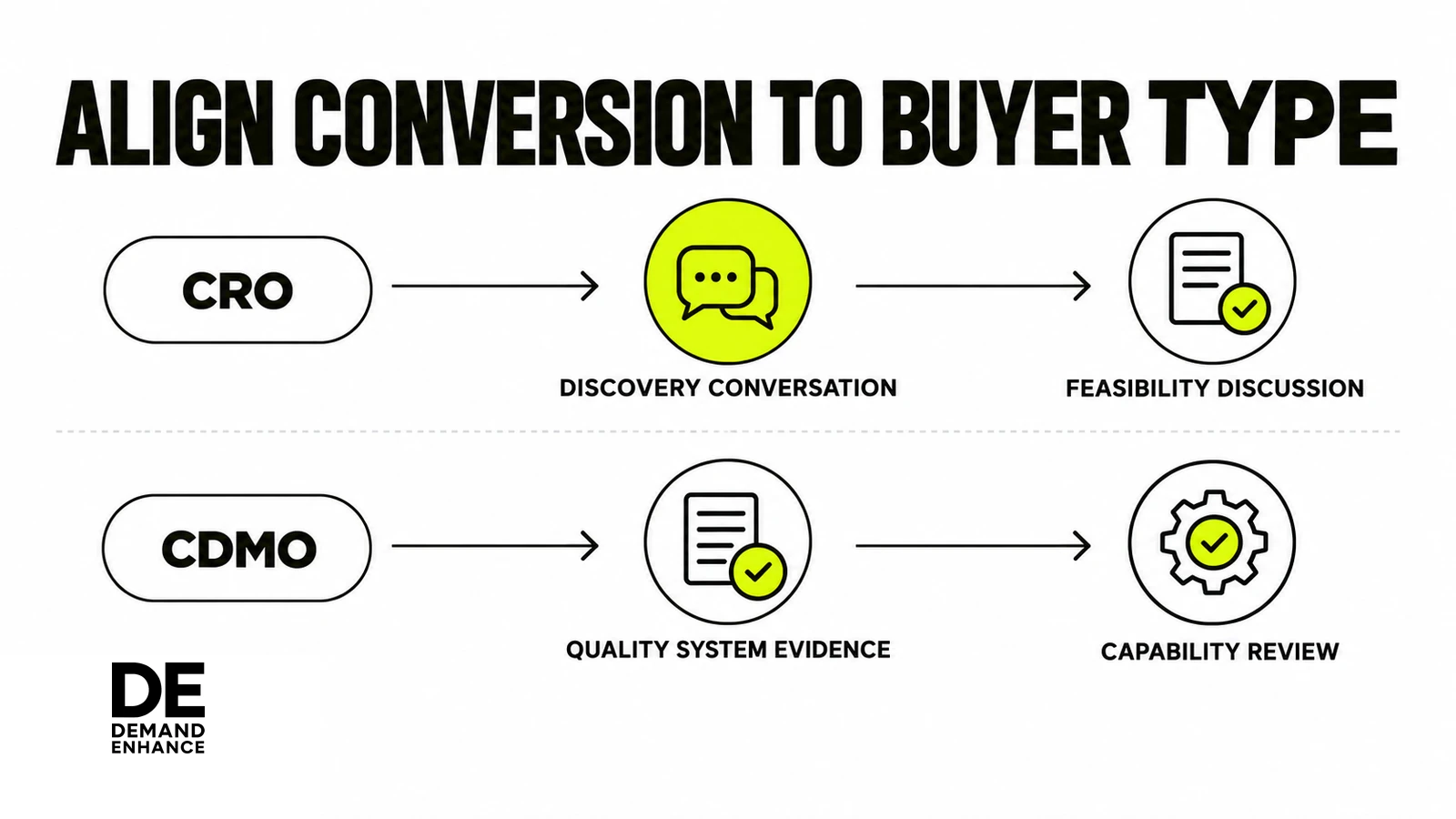
CRO conversion tends to be relationship-led. The initial conversion goal is usually a conversation — a discovery call, a capabilities presentation, or a feasibility discussion. Lead magnets should be operationally useful: RFP templates, phase-specific checklists, site selection frameworks.
CDMO conversion tends to be evidence-led. Technical buyers want to review capability documentation before committing to a conversation. Lead magnets should be technically substantive: formulation capability overviews, analytical method summaries, technology transfer case study packages.
What This Means for Dual-Service Organisations
For organisations that provide both CRO and CDMO services, the temptation to build a single integrated content strategy is strong. Resist it. The buyer audiences, search vocabularies, content needs, and conversion paths are different enough that a unified strategy will systematically underserve both.
The more effective approach is to build two parallel content architectures within the same site: one for CRO buyers and one for CDMO buyers, each with its own topic cluster, its own internal linking structure, and its own conversion path. These architectures can share the site’s domain authority and overall SEO strength without conflating the buyer journeys.
Next Steps
Whether you are a CRO, a CDMO, or a dual-service organisation, the strategic takeaway is the same: build your content and SEO architecture around your buyer’s actual search behaviour, decision criteria, and trust requirements — not around your internal service taxonomy.
If you are unsure whether your current strategy is correctly calibrated to your buyer type, request a marketing strategy session with DemandEnhance. We will analyse your current content architecture against the CRO vs CDMO buyer model and identify where your strategy is leaving qualified traffic unconverted.
Match the page to the buyer
| Page question | CRO focus | CDMO focus |
|---|---|---|
| Capability | Study types, methods and relevant expertise | Development stage, process and manufacturing capability |
| Evaluation | Evidence that supports a research brief | Evidence that supports development or supply requirements |
| Next step | Discuss the study scope | Discuss the project or manufacturing scope |
Frequently asked questions
How should CRO and CDMO teams test assumptions about buyer risk?
Use customer conversations and verified service requirements to identify what buyers need to evaluate. Test research scope, operational coordination, development, manufacturing, and process-transfer questions where relevant, rather than assuming every organization or procurement team follows the same priorities.
Should a dual-service organization combine CRO and CDMO SEO content?
It can share technical foundations and brand standards while giving each audience a clear path to relevant services, evidence, and terminology. Cross-link where a genuine relationship helps readers; avoid blending distinct buyer questions into generic pages.
What evidence is useful on CRO and CDMO capability pages?
Use proof that fits the capability and can be disclosed responsibly. CRO resources may explain study context and delivery methods; CDMO resources may describe relevant process or quality experience. Review all claims with the appropriate subject-matter and compliance owners.
Sources and further reading
Demand Enhance
Separate buyer needs before planning content
Bring your CRO and CDMO service lists, audiences, and approved proof assets to a content architecture discussion with Demand Enhance. Map where separate topic paths are useful and where shared resources serve both buyers.
Discuss your priorities