When B2B biopharma marketers plan their content strategy, the default procedural approach often relies heavily on third-party search volume metrics. The prevailing instinct is to find queries returning high quantitative monthly search estimates, publish targeted pages to theoretically capture that traffic, and assume the resulting visibility will cascade naturally down into the commercial sales pipeline. In the complex life science sector, however, optimizing strictly for keyword volume leaves critical gaps in the buyer’s journey and frequently misaligns with the reality of technical procurement.
Why Topical Authority Matters More Than Keyword Volume in Life Science SEO
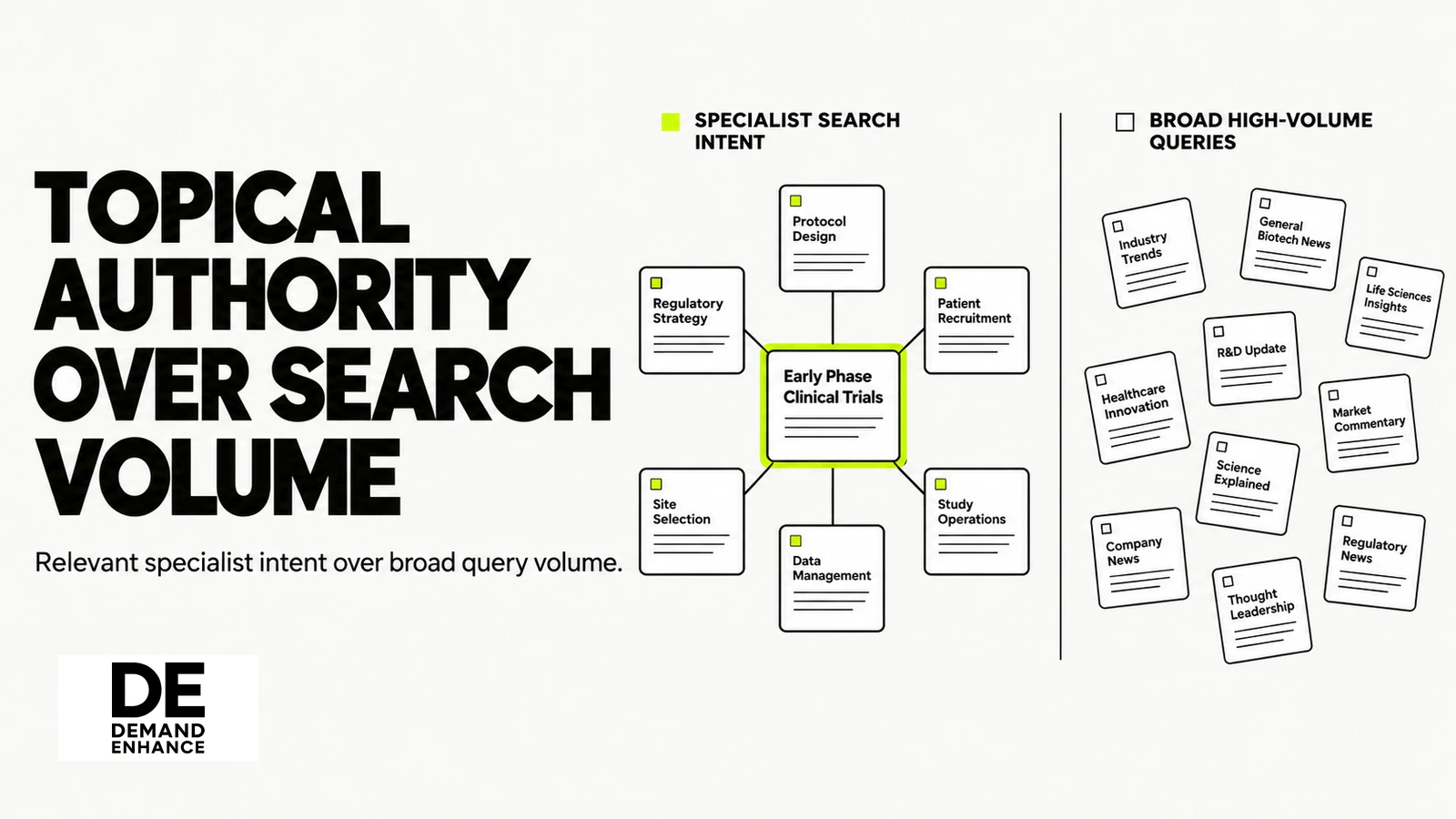
Rather than chasing generalized traffic based on volume, a mature marketing operation treats "topical authority" as a structured editorial and site-planning framework. This approach ensures that a website anticipates and comprehensively answers the highly technical, logically interconnected questions asked by specialized researchers, clinicians, procurement heads, and quality assurance leads. The goal is to purposefully build coherent coverage around a defined subject area—not simply to accumulate isolated blog posts targeting high-volume query strings.
Why a Search-Volume Estimate Is Only One Input
Search-volume metrics serve as a helpful starting point to estimate observable, broad-level market demand. However, relying exclusively on volume as the primary mechanism for planning technical content often leads to distinct strategic blind spots in B2B life sciences. Volume must be balanced with intent.
What a keyword tool can and cannot tell a technical marketer
Third-party keyword tools aggregate historical search data. They can reveal how frequently a specific term was typed into a search engine over a given historical period, offering a generic mathematical baseline of interest. What these software platforms absolutely cannot tell a technical marketer is the contextual driver behind the query, the scientific sophistication of the individual user, or the potential commercial value of the visitor.
A traditional keyword tool cannot reliably distinguish between a procurement director heavily vetting a contract development and manufacturing organization (CDMO) for an impending project transfer, and an undergraduate biology student defining a general term for a laboratory report. Treating search volume as the ultimate, overriding measure of commercial opportunity risks optimizing your organization’s digital footprint for the audience segment least likely to legitimately partner with your firm. Volume provides context, but it does not dictate commercial relevance.
Why broad traffic can be disconnected from the buyer’s task
High-volume terms frequently lack dedicated commercial intent. Consider a broad query representing a general biological concept. While the volume estimate from an established platform might be massive, the individuals querying this broad term are rarely looking for a bioanalytical testing partner or a specialized outsourced manufacturing vendor. They are frequently seeking basic definitions, historical industry background, or early-stage educational resources.
Conversely, a highly specific query exploring the optimization constraints of a niche biologics process may register as extremely low volume in a keyword research tool due to its specialized nature. Yet, the scientist entering that exact string is diagnosing a live, current problem—a problem that could translate into a significant professional engagement. Broad traffic creates a mirage of marketing success, but it often remains disconnected from the specific evaluation tasks that specialized buyers perform when actively sourcing vendors.
What “Topical Authority” Means as a Planning Framework
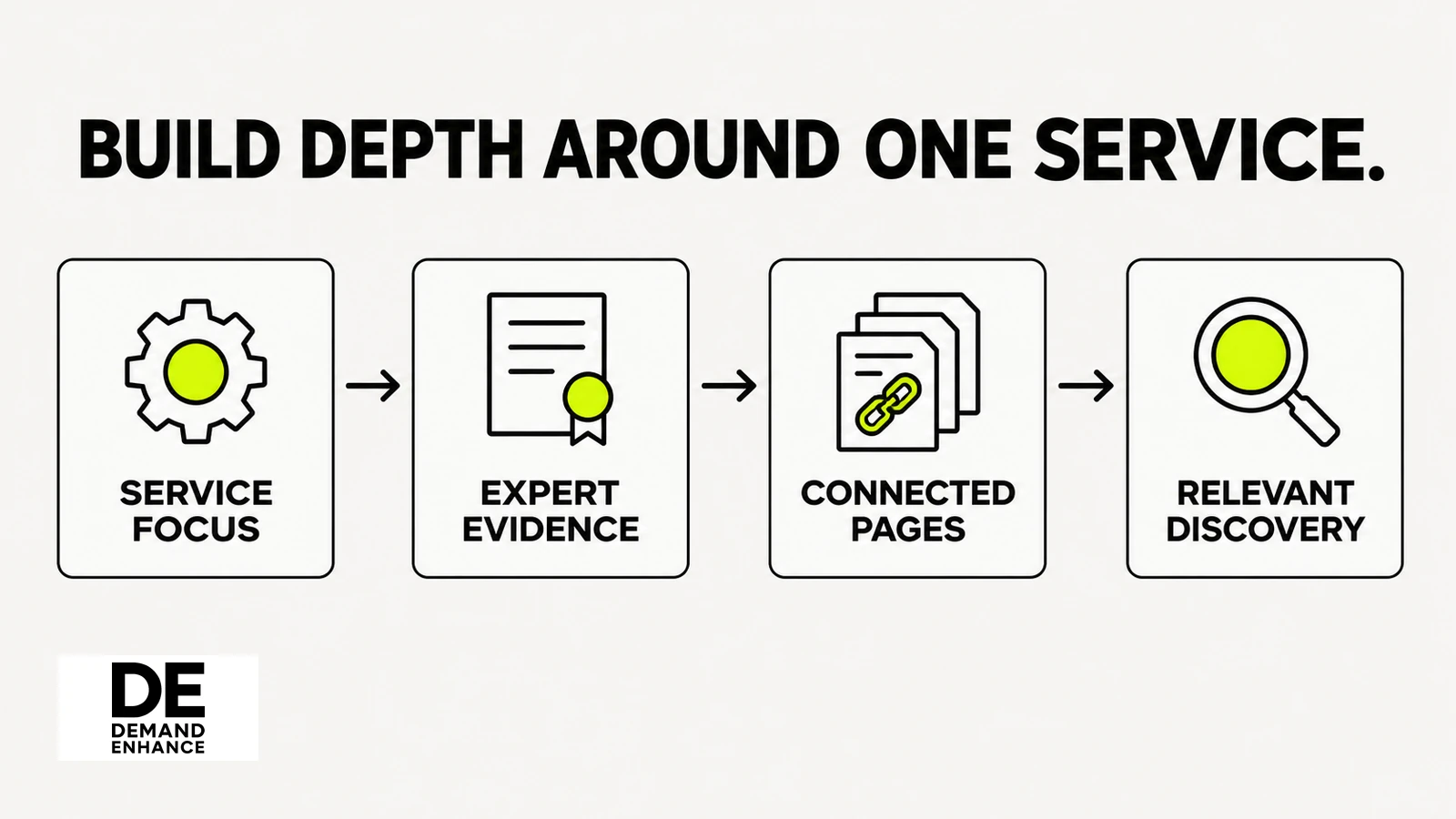
In a technical life science marketing context, “topical authority” should not be treated as a directly measured Google ranking factor, nor is it a guaranteed algorithm hack. Instead, it is a highly structural editorial methodology used to organize content logically and comprehensively. It provides a blueprint to ensure your website operates as a cohesive, reliable library that actively supports technical decision-making.
A defined subject area, connected questions, and useful page roles
Building out structural topical coverage requires looking at a specialized subject area and exhaustively documenting the chain of questions a prospect will logically ask on their path toward a procurement decision. If your firm’s expertise lies in a specific modality of vector manufacturing, maintaining this editorial framework requires establishing the interconnected landscape thoroughly covering that subject.
This process directly includes creating the overarching primary service page, deploying specialized sub-pages distinguishing between distinct cell cultivation methods, and organizing troubleshooting resources on specific downstream purification constraints. Each page must establish a distinct, useful role in guiding the evaluator forward. Rather than drafting repetitive, shallow posts to capture superficial variations of a manufacturing target keyword, the framework dictates engineering a network of resources that sequentially addresses facility capacity, specialized scale-up challenges, analytical testing requirements, and localized regulatory support mechanisms.
Coverage, depth, evidence, and expert review
Using AI SEO to review topic coverage may help identify candidate questions across specialized life science domains. After an authority audit, a scoped Agentic SEO pilot can support the review; domain specialists should assess evidence and decide whether to build, improve, consolidate, or defer each page.
A comprehensive editorial content strategy actively evaluates a proposed topic not just by the sheer breadth of its coverage, but critically by its technical depth and evidentiary standard. Life science buyers evaluate outsourced risk above all else. Consequently, generating effective site coverage demands far more than generalized marketing copy—it demands precision and verification.
An editorial framework forces a diagnostic check: Have the stated capabilities been backed up with verified facility data, specific equipment lists, and validated technical outcomes? Have internal subject-matter experts explicitly reviewed the material to ensure standard operating procedures and nuanced regulatory compliance methodologies are represented accurately? Achieving perceived topical coverage without rigorous expert depth typically yields superficial filler content that actively erodes a brand’s technical credibility during a complex vendor assessment.
How to Map a Life-Science Topic Without Publishing for Its Own Sake
Adopting a comprehensive editorial framework absolutely does not mean publishing endless glossaries purely to claim a topic has been covered. It directs marketing teams to map out genuine informational needs based entirely on what the primary target audience actually requires to resolve their operational or scientific bottleneck.
Topic coverage review checklist
- List the buyer tasks and verified services within one topic area before reviewing search-volume estimates.
- Check existing pages for missing answers, overlap, outdated claims, weak evidence, and links to relevant capability information.
- Assign a clear action to each gap: improve, consolidate, build a distinct resource, or defer until the team can support it.
Put the idea into practice
Choose an action for a niche topic
A low-volume query matches a real technical question, but an existing service page mentions it only briefly. What should the team do?
Improve the existing page
Choose this when the query shares the page's main intent and the team can add accurate detail without making the page unfocused. Expand the relevant section, support its claims, and link to a separate resource only if the buyer needs more depth.
Create a distinct resource
Choose this when the query represents a different buyer task that deserves its own complete answer and evidence. Define how it differs from the service page, then connect the two so readers can navigate between education and capability.
Review topic coverage in sequence
Map the buyer task
Describe the audience, service context, and decision question for one topic area. Use keyword data as an input, then confirm that the topic reflects a real need the organization can address.
Audit existing pages
Review each related URL for useful detail, evidence, current scope, overlap, and internal links. Note where a page is thin or outdated instead of assuming every gap requires a new article.
Select the editorial action
Choose build, improve, consolidate, or defer and record the reason. Assign an owner and evidence source so the decision can be revisited when services or supporting material change.
Select a step to explore the idea.
Start with services, audiences, workflows, and problems
Begin the mapping architecture inherently by documenting your verified operational capabilities. Align these confirmed capabilities directly with the specific audiences authorized to purchase them—whether that means bench scientists sharply focused on early assay development, or operations directors mitigating supply chain continuity risk.
Next, break down their clinical or manufacturing workflows. Identify precisely where these roles commonly encounter operational friction. When a procurement leader seeks to switch analytical testing labs due to consistency deviations, what exact technical parameters are they attempting to resolve? Planning your topics deliberately around these workflows ensures your content strategy remains anchored in provable commercial utility rather than abstract search spreadsheets.
Group questions by intent and the answer each page should provide
Once a marketing team identifies the sequential challenges an audience faces, group these interconnected queries carefully by user intent. An evaluator operating in the very early conceptual stages of a project might search only for the theoretical limitations of a specific bioprocessing method. A different evaluator, residing much further along in the buying cycle, may need to explicitly verify whether a given facility currently holds the necessary regulatory qualifications to manage later clinical trial materials.
Assign one clear, dominant technical answer that each specific URL should confidently own. This rigorous assignment prevents your site from hosting poorly defined, loosely related pages that confuse technical readers and dilute your organization’s core scientific message.
Connect pages with links that explain their relationship
Broad coverage only functions as a truly effective planning framework when the relationship operating between corresponding pages is obvious and explicitly linked. Internal links must serve as reliable, logical bridges that accurately anticipate the technical reader’s next investigative requirement.
If a prospective client is reading an in-depth summary resource concerning the complexities of navigating early investigational submissions for a novel biologic, an internal link should seamlessly direct them over to a dedicated regulatory consulting capability page. The internal site architecture must empower readers to transition intuitively from identifying their core process problem, to exploring a verified technical methodology, toward finally evaluating your specific service offering.
A Practical Coverage Review
To operationalize this theoretical approach, your commercial team must periodically audit its existing published content not merely for traffic acquisition, but for comprehensive, accurate scientific utility. Transitioning from theory to practical application requires a highly disciplined evaluation of your current corporate assets.
Check relevance, completeness, evidence, usability, and upkeep
Initiate a systematic, critical review of your priority topic areas. Evaluate each existing URL based on restrictive criteria. Is the provided information still highly relevant to the active services your company currently supports? Is the treatment of the scientific topic complete, or does it gloss over the technical nuances that fundamentally matter most to advanced buyers?
Critically assess the available evidence—are the data points, regulatory guidelines, and equipment references current and factually accurate? Furthermore, verify the digital usability of the resulting page. Technical evaluators have an incredibly low tolerance for friction; if they cannot easily locate your assay validation protocols or facility parameters, they will exit. Finally, confirm upkeep. Life sciences move responsibly, and an article citing outdated regulatory guidance introduces serious reputational risk.
Decide what to build, improve, consolidate, or leave unpublished
An effective coverage review should culminate directly in clear, assignable editorial actions. Not all identified content gaps mandate a net-new page. In many operational scenarios, deliberately consolidating three thin posts into one comprehensive, technically robust master resource creates a vastly superior experience for the critical evaluator.
Alternatively, a team may determine they need to drastically improve existing service pages by integrating more rigorous subject-matter expert insights and verified technical specifications. In instances where a proposed topic falls distinctly outside your current verifiable capabilities—even if the raw search volume appears highly tempting—the most strategic choice is often to decisively leave the concept unpublished.
Balance Coverage with Demand and Business Fit
A mature content program respects established search demand without routinely being dictated by it. Keyword research tools can help compare observable demand among topics that fit your services, but demand alone is insufficient.
You must routinely intersect this apparent demand with strict, honest business fit. A framework must balance generalized awareness with deep specialization. For a broader strategic case examining why specialized technical buyers frequently respond better to deep expertise than to high-volume top-of-funnel content, consider reviewing Why SEO in Pharma Is More About Authority Than Traffic.
Furthermore, merely writing about a complex topic is entirely insufficient if your overarching site architecture actively fails to adequately support logical user conversion. The fundamental mechanics of organizing these distinct page roles into a cohesive commercial journey are fundamentally essential to long-term operational success. To explore the structural execution required for this editorial framework, see How to Build a CRO SEO Content Hub That Attracts Sponsors, Not Just Traffic. Balance requires guaranteeing that every asset you invest in producing actively serves your primary commercial offering.
A Short Action Plan for the Next Review Cycle
Moving intelligently past volume-obsessed metrics requires a fundamental, lasting shift in how your entire team plans online content. For an upcoming review cycle, initiate the shift by systematically mapping out a single, core institutional capability.
Identify the interconnected questions your top-tier clients frequently pose during early sales processes. Follow this by exhaustively auditing your existing related pages to detect where answers remain missing, outdated, or poorly connected. Tie this executed editorial standard firmly back to tangible commercial outcomes by aligning your review strictly with a measurable pipeline focus. For guidance on tracking the impact of these methodical changes over the long term, consult How to Measure Lead Quality from SEO in Long-Sales-Cycle Life Science Companies. By treating topical coverage firmly as a restrictive editorial standard rather than merely a theoretical ranking mechanism, a team effectively builds a digital library that consistently supports complex B2B evaluations.
To discuss your life science content strategy, contact Demand Enhance.
Frequently asked questions
Is topical authority a measured Google ranking factor?
In this article, topical authority is an editorial planning concept for organizing useful, connected coverage. It should not be treated as a guaranteed ranking mechanism; each page still needs a distinct purpose, accurate information, and value for its intended reader.
How should a life science team prioritize low-volume topics?
Assess whether the topic matches a verified service, a real buyer question, and evidence the organization can provide. Search-volume estimates can inform prioritization, but they do not establish commercial fit or the value of a specialized inquiry.
Should every missing topic become a new article?
No. A review may point to improving a service page, consolidating overlapping posts, creating a genuinely distinct resource, or leaving a topic unpublished. Choose the format that answers the buyer's question accurately without stretching beyond current capabilities.
Sources and further reading
Demand Enhance
Turn topic coverage into an editorial review
Discuss how to assess topic coverage against buyer needs, evidence, and current services with Demand Enhance. Bring one capability area and its existing pages for a focused planning conversation.
Discuss your priorities