When evaluating a contract development and manufacturing organization (CDMO), life science buyers conduct an in-depth technical risk assessment rather than casual browsing. The visitors reviewing a CDMO site typically include procurement directors, quality assurance managers, and process engineers. These professionals evaluate prospective manufacturing partners on specific parameters: facility scale, batch capacity, regulatory inspection history, technology transfer workflows, and analytical quality controls.
Why CDMO Websites Fail to Convert Technical Buyers
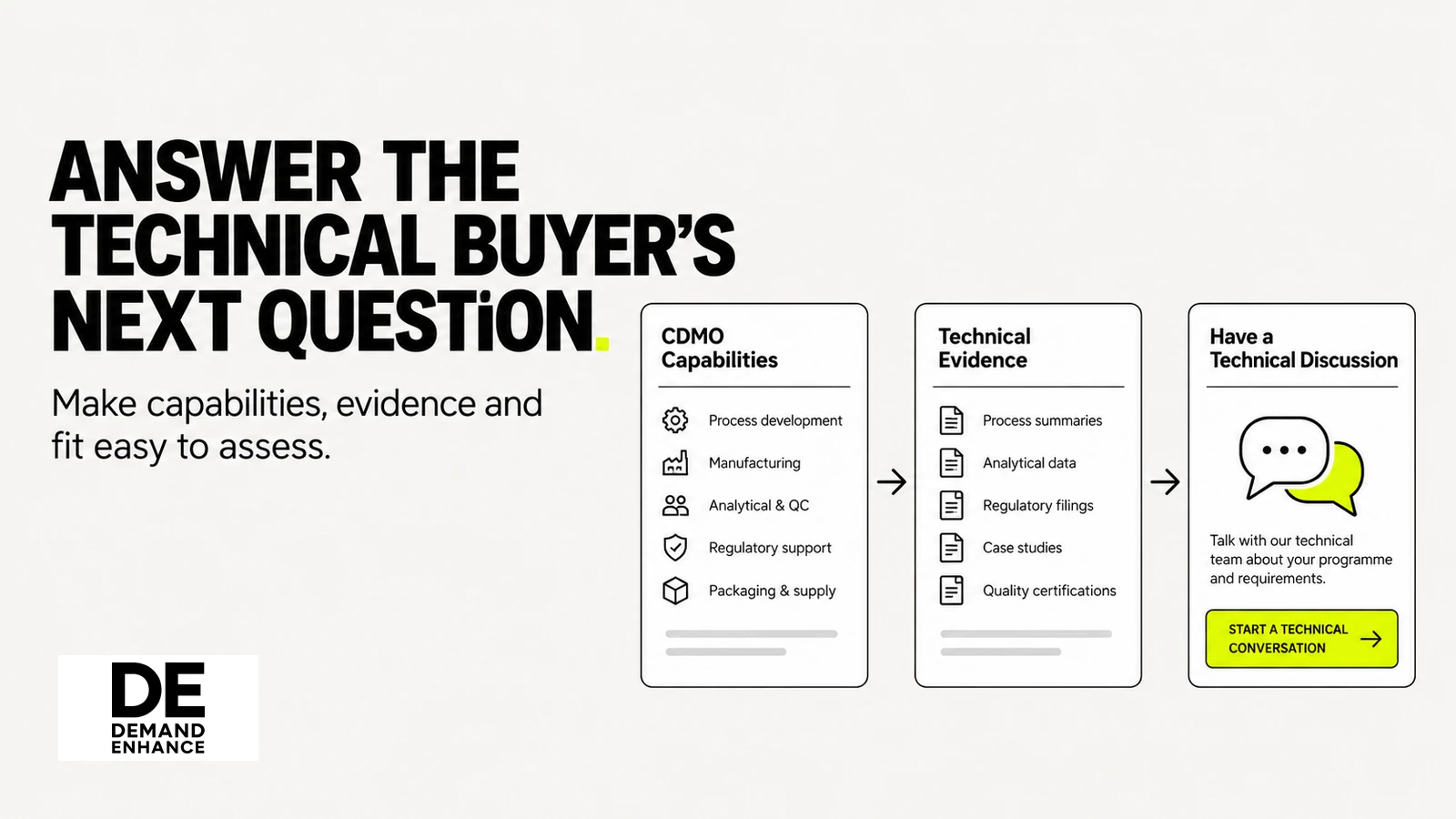
Despite the technical nature of these evaluations, a CDMO website can create friction when it relies on vague claims, omits practical operational boundaries, or hides essential documentation. Rather than helping an evaluator confirm compatibility, an unclear website can prompt a technical team to look elsewhere for answers. Understanding how technical evaluators assess providers helps CDMOs design sites that answer key questions and support qualified inquiries.
What a Technical Visitor Needs to Establish
Technical buyers visit a CDMO website with specific questions about project feasibility. Their main goal is to determine whether a provider’s facilities, quality standards, and technical expertise match their project parameters.
The service, product type, and project scope that fit
The first requirement for an evaluator is determining basic scope compatibility. A process engineer evaluating an outsourced partner needs to know whether the facility handles their molecule type, dosage form, or expression system.
For example, an evaluation team may need to verify whether a facility has dedicated containment for potent compounds or specific bioreactor volumes for mammalian cell culture. Broad statements about end-to-end capabilities do not answer these questions. Evaluators look for clear details about production scale, process capabilities, and equipment types. If an inquiry team cannot determine whether a facility supports clinical batch production or commercial-scale manufacturing, they may conclude the provider cannot support their project.
The evidence and constraints relevant to the visitor’s evaluation
Beyond basic service availability, technical evaluators require supporting evidence and clear boundaries. In regulated pharmaceutical manufacturing, unsupported marketing claims introduce perceived risk.
Evaluators look for details regarding quality management systems, analytical testing capabilities, and technology transfer protocols. They also value clear statements of operational limits. Stating technical boundaries—such as minimum batch sizes, viscosity limits, or working temperature ranges—builds confidence. Technical buyers respect providers that state their operational scope clearly, because precise boundaries indicate process discipline and regulatory maturity.
Where a Website Can Create Avoidable Friction
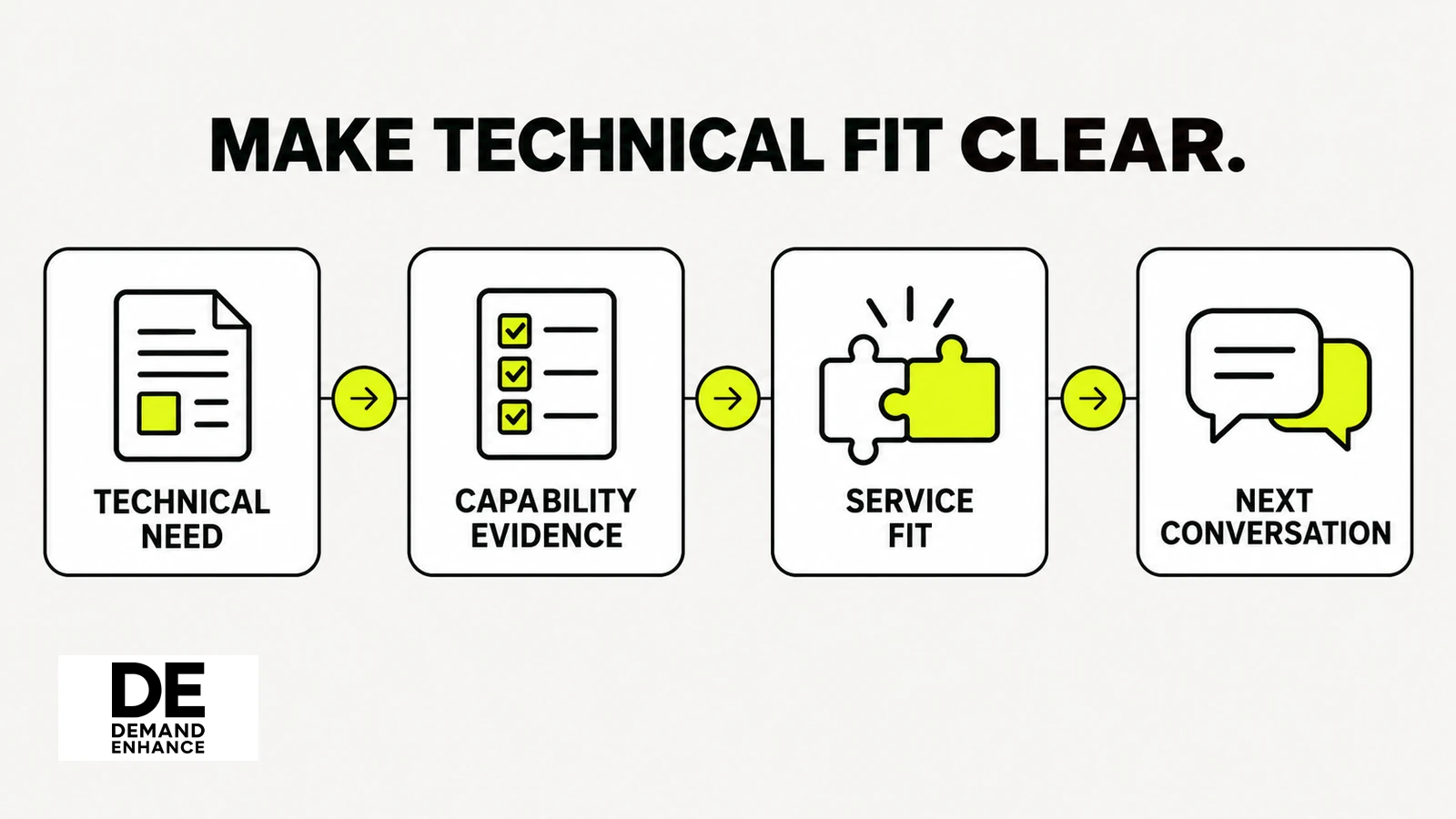
Even when a CDMO maintains modern facilities and strong compliance records, website structure and copy can create unnecessary hurdles for prospective clients. Recognizing common points of friction helps marketing and technical teams improve the visitor experience.
General claims that do not explain actual capabilities
A site can create friction when it relies on broad promotional slogans instead of technical facts. Phrases promising unmatched quality, seamless collaboration, or rapid delivery take up page space without answering technical questions.
When a quality manager visits a site to verify whether a facility operates under cGMP standards for aseptic fill-finish operations, general statements about excellence do not help. Relying on broad marketing language forces visitors to search through multiple pages to find basic operating details, increasing the chance they abandon the review.
Important scope information that is difficult to find or compare
Friction also occurs when essential technical details are hard to locate. When a website buries key specifications—such as reactor volumes, cleanroom classifications, fill speeds, or packaging formats—inside downloaded brochures or poorly labeled menus, evaluators struggle to verify project fit.
Technical visitors need easily scannable information. Hiding operational parameters makes it difficult for evaluation teams to compare providers against their technical requirements, creating unnecessary delays in the evaluation process.
Resources that do not answer the next technical question
CDMO websites sometimes publish general blog posts about broad industry trends that do not serve technical buyers. When an engineer finishes reading an overview of a continuous manufacturing workflow, offering a general opinion piece on pharmaceutical market growth does not answer their technical questions.
Technical evaluators benefit more from detailed case examples, protocol summaries, or technical notes that demonstrate how a team addressed a specific formulation or scale-up challenge. Providing irrelevant promotional content interrupts the evaluation process.
Make Service Pages Useful to Technical and Commercial Readers
Service pages must serve both technical scientists assessing feasibility and commercial managers evaluating supply reliability. Structuring pages to address both perspectives improves clarity for the entire evaluation committee.
Describe verified processes, boundaries, and intended applications
Through Agentic SEO, a scoped pilot may help CDMOs outline how engineering specifications and batch capabilities appear on service pages. After an architecture audit, engineering owners should verify facility parameters against current documentation and identify what requires a project-specific discussion before page updates are published.
Service pages should clearly outline active laboratory and manufacturing workflows. State the specific technologies, instrumentation platforms, and formulation methods used in routine operations.
Specify operational boundaries clearly:
- State working volumes, batch size ranges, and container compatibility.
- Clarify whether capabilities apply to preclinical material, clinical trials, or commercial supply.
- Describe supported delivery mechanisms or dosage forms.
Explaining verified capabilities alongside operational boundaries allows evaluators to confirm whether a provider’s facilities fit their project scope.
Make quality, facility, and regulatory information precise and current
Regulatory compliance and facility standards are central to every CDMO evaluation. Teams must keep facility descriptions, inspection records, and quality certifications accurate and up to date.
If a facility has completed inspections by regulatory authorities, maintains ISO certifications, or holds specific licenses for controlled substances, display those credentials clearly on relevant service pages. Providing clear compliance information addresses basic due-diligence questions early in the review.
Identify what requires a confidential or project-specific discussion
Certain proprietary methods and specialized project parameters cannot be published openly on a public website. Marketing and technical teams must distinguish between information suitable for public pages and details that require a non-disclosure agreement (NDA).
Clearly state when specific technical parameters require a confidential discussion. Letting visitors know that detailed yield projections, custom tooling options, or project-specific timelines are discussed under an NDA clarifies the next step for the evaluator and encourages a formal inquiry.
Design an Inquiry Path That Matches the Evaluation Stage
A well-documented service page can lose qualified inquiries if the contact process is poorly designed. The inquiry path should accommodate the different evaluation stages common in long procurement cycles.
CDMO service-page clarity checklist
- Place approved product types, process scope, scale parameters, and operating boundaries where technical evaluators can find them.
- Show current quality and facility information with review ownership, and identify details that require a confidential discussion.
- Offer concise inquiry routes and ask only for high-level information needed to direct the request.
Put the idea into practice
Choose the first CDMO page fix
Technical visitors can find the contact form, but they cannot quickly determine whether the facility fits their project. What should be fixed first?
Clarify scope and boundaries
Choose this when core specifications or supported project stages are hard to find. Surface approved product types, processes, scale, and limits before adding more promotional language or asking visitors for detailed project information to assess fit.
Refine the inquiry route
Choose this when the page already explains fit but provides only one generic contact path. Offer stage-appropriate options, state what information is needed, and describe confidentiality or follow-up only as the team actually handles it.
Make the evaluation path clearer
Surface project fit
Identify the information a technical and commercial evaluator needs first: supported scope, product type, process, and operational boundaries. Publish only current details approved by the responsible facility owners.
Show supporting evidence
Place relevant quality and facility context near the claims it supports. Mark which details are public and which require a project-specific or confidential discussion under the organization's established process.
Route the inquiry
Offer a clear next step for a feasibility question or formal request, if both routes exist. Keep the initial form concise and explain follow-up only when the internal process is confirmed.
Select a step to explore the idea.
Give the visitor a clear choice of next step
Different visitors arrive at different stages of their decision-making process. A procurement lead preparing a formal request for proposal (RFP) needs a direct way to submit project specifications, while a project manager exploring feasibility may prefer a technical consultation with an engineer.
Offering only a single, generic contact form can create hesitation. Providing distinct options—such as requesting a formal proposal, scheduling an introductory technical call, or asking a specific feasibility question—allows evaluators to choose the step that matches their project stage.
Ask only for information needed to route the inquiry
Inquiry forms should collect only the information necessary to direct the request to the right technical or business development team. Technical evaluators are often reluctant to share proprietary molecule details or confidential timelines on an open web form.
Keep initial forms concise:
- Collect basic contact details and organizational affiliation.
- Ask for the general service area or project stage.
- Include an optional field for project requirements or questions.
Different life-science service models require different marketing and conversion paths. As examined in CRO vs CDMO Marketing: Why the Same SEO Strategy Does Not Work for Both, CDMOs and CROs serve different operational needs. Note that the CRO-specific recommendations discussed in What Every CRO Service Page Needs to Convert Sponsor Traffic apply to clinical research services and should not be treated as a CDMO standard.
Explain who responds and what happens next, only if confirmed
Technical buyers appreciate knowing how their inquiry will be handled. If your organization has an established process where an inquiry is reviewed by a technical director within two business days, state that on the confirmation page.
Only describe response timelines and personnel roles if your internal team consistently maintains those commitments. Providing a clear explanation of what happens after submitting an inquiry builds confidence during initial contact.
Keep the Website Aligned with Operations
A CDMO website must accurately reflect actual facility capabilities and operational changes. Maintaining accuracy requires ongoing collaboration between marketing, facility managers, and quality teams.
Assign owners for capability statements and evidence
Assign clear internal ownership for each technical claim, equipment list, and compliance statement on the website:
- Quality assurance managers should review compliance and regulatory statements.
- Facility and operations leads should verify equipment lists and capacity specifications.
- Technical directors should approve descriptions of analytical methods and manufacturing workflows.
Documenting ownership ensures that published content reflects real operational standards.
Review content when services or constraints change
Establish a process to update web content whenever facility operations change. When new equipment is qualified, cleanroom space is expanded, or a method is retired, the website should be updated promptly.
Publishing outdated specifications or retired capabilities can lead to mismatched inquiries and waste time for both the buyer and your internal teams. For insights on tracking inquiry quality in long sales cycles, review How to Measure Lead Quality from SEO in Long-Sales-Cycle Life Science Companies.
A CDMO Website Self-Review Checklist
To evaluate whether your website supports technical buyers effectively, review your service pages against this diagnostic checklist:
- Scope clarity: Can a visitor quickly identify the molecules, dosage forms, or project phases supported by each facility?
- Technical parameters: Are equipment models, batch ranges, and process limits clearly stated on capability pages?
- Compliance visibility: Are regulatory inspection histories, cGMP standards, and quality certifications displayed prominently?
- Resource relevance: Do case studies and technical notes address practical development and manufacturing challenges?
- Inquiry structure: Does the site offer clear paths for both general technical questions and formal RFP submissions?
- Data protection: Does the site clearly explain when confidential discussions or NDAs are appropriate before requesting proprietary details?
Addressing these points helps a CDMO present its technical capabilities clearly, reduce friction for prospective clients, and support qualified technical evaluations.
To evaluate your website’s technical content and conversion structure, contact Demand Enhance.
Frequently asked questions
Which technical details help a CDMO service page qualify project fit?
Useful details may include supported product types, process scope, equipment or scale ranges, quality context, and known operating boundaries. Publish only current, approved information that the relevant operations and quality owners can substantiate.
How can a CDMO explain proprietary details it cannot publish?
State which information is public and which requires a confidential or project-specific discussion, using the organization's established process. Avoid collecting sensitive project information through an unprotected form or implying an NDA workflow that has not been confirmed.
What should an initial CDMO inquiry form ask?
Request only the contact and high-level service context needed to route an inquiry, such as the general area of interest and a question. Keep confidential molecule, protocol, or timeline details optional until an appropriate discussion channel is established.
Sources and further reading
Demand Enhance
Review your CDMO pages for evaluation friction
Discuss how your CDMO website presents verified scope, technical evidence, and inquiry pathways with Demand Enhance. Bring a priority service page and the internal owners responsible for its operational claims.
Discuss your priorities