
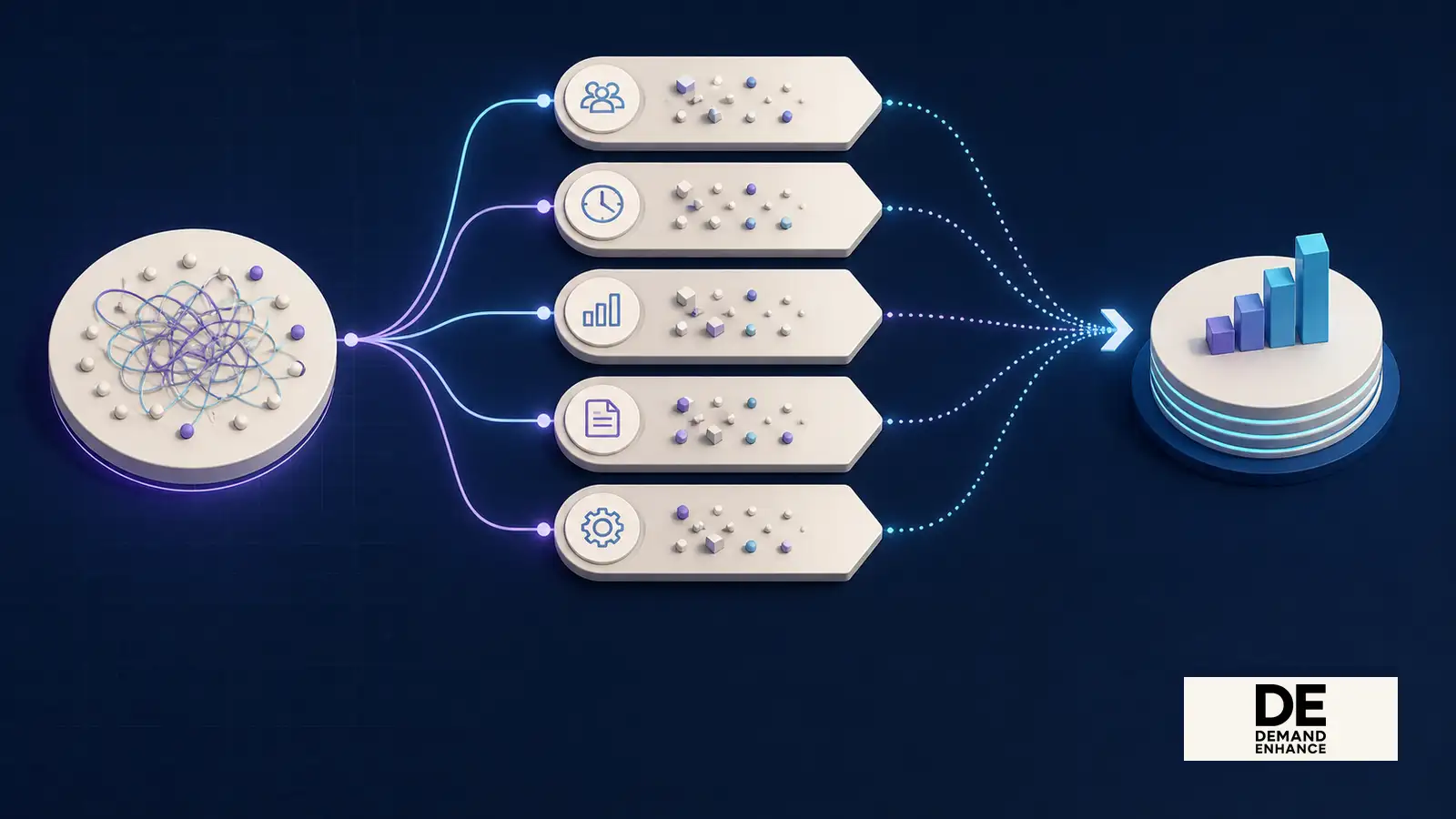
If you run a clinical trial vendor — a CRO, a patient recruitment organisation, an eClinical technology provider, a site management organisation, or any other service provider in the clinical trial ecosystem — your SEO strategy is probably built around the wrong keywords.
The typical clinical trial vendor targets category keywords: ‘clinical trial CRO’, ‘patient recruitment services’, ‘EDC software’, ‘site management organisation’. These terms describe what you do. The problem is that sponsors searching for vendor partners rarely search for what a vendor does — they search for what a problem feels like when it is happening to them.
This guide explains the difference between vendor category keywords and sponsor problem keywords, why the latter are more valuable, and how to build a clinical trial vendor SEO strategy around the problems sponsors actually search for.
The Vocabulary Gap Between Vendors and Sponsors
Every clinical trial vendor has a service vocabulary. CROs talk about ‘clinical trial management’, ‘protocol optimisation’, ‘site monitoring’. Patient recruitment companies talk about ‘participant identification’, ‘enrolment acceleration’, ‘screen failure reduction’. eClinical vendors talk about ‘EDC’, ‘CTMS’, ‘eTMF integration’.
Sponsors in the middle of a trial problem are not using this vocabulary. They are using the language of the operational experience they are living through. They search for:
- ‘clinical trial enrollment delays causes’
- ‘how to fix slow site activation Phase II’
- ‘vendor communication problems clinical trial’
- ‘why is my CRO missing milestones’
- ‘IND amendment how long does it take’
These are the searches that happen at three in the morning when a programme director is staring at a red timeline. They are high-intent, low-competition, and almost entirely unaddressed by clinical trial vendors whose SEO focuses on service category terms.
A Taxonomy of Sponsor Problem Searches
Sponsor problem searches cluster around five operational domains. Here is a framework for mapping your services to each domain.
Study startup and site activation
Startup delays are one of the most common sponsor complaints. Problem searches in this domain include: ‘clinical trial site activation timeline’, ‘study startup checklist CRO’, ‘how long does site activation take Phase II’, ‘IRB submission delays causes’, ‘pharmacy activation clinical trial’. Vendors with site activation expertise — CROs, site management organisations, regulatory support providers — should be ranking for these terms.
Enrolment and recruitment
Enrolment shortfalls are the most financially significant problem in clinical trial operations. Problem searches include: ‘clinical trial enrollment behind schedule’, ‘patient recruitment strategy Phase III’, ‘screen failure rate high causes’, ‘rare disease enrollment challenges’, ‘how to accelerate clinical trial enrollment’. Patient recruitment vendors, CROs with recruitment capabilities, and decentralised trial solution providers are the natural owners of these searches.
Vendor oversight and communication
Sponsor-CRO relationship problems are a persistent operational challenge. Problem searches include: ‘managing CRO performance’, ‘CRO communication problems’, ‘vendor oversight clinical trial’, ‘how to get better reporting from CRO’, ‘sponsor CRO relationship best practices’. This search territory is almost entirely unaddressed by CROs — a significant gap.
Data and regulatory challenges
Data quality, query resolution, and regulatory timeline problems generate a distinct set of searches: ‘clinical trial data cleaning timeline’, ‘how to reduce database lock time’, ‘IND amendment timeline FDA’, ‘protocol deviation management’, ‘CAPA clinical trial’. eClinical vendors, regulatory consultants, and data management CROs can own significant search territory here.
Programme financial and timeline management
Budget overruns and timeline delays are a constant sponsor concern. Problem searches include: ‘clinical trial budget overrun causes’, ‘Phase II cost management’, ‘CRO change order management’, ‘clinical trial timeline compression’, ‘how to manage scope creep clinical trial’. Full-service CROs and project management specialists can build strong content in this domain.
How to Map Sponsor Problems to Your Services and Pages
For each problem search cluster, identify the service or capability you have that addresses it. Then create a direct mapping: sponsor problem query → content that addresses the problem → service page that provides the solution.
This three-tier mapping is the core architecture of a problem-led clinical trial vendor SEO strategy. Without the explicit link from problem content to service pages, your problem-aware content will generate traffic but not conversion.
Example mapping for a site management organisation:
- Problem query: ‘clinical trial site activation delays causes’ → Problem content: ‘The five most common causes of site activation delay and how to address them’ → Service page: Site Activation Support Services
- Problem query: ‘IRB submission timeline how long’ → Problem content: ‘IRB submission timelines by study type: what to expect and how to plan’ → Service page: Regulatory Support for Site Activation
- Problem query: ‘pharmacy activation clinical trial checklist’ → Lead magnet: Pharmacy Activation Checklist → Service page: Pharmacy Activation Services
The Conversion Architecture for Problem-Led Content
Problem-led content attracts sponsors who are in the middle of a live operational challenge. This is an unusual conversion context: the reader is not evaluating vendors, they are solving a problem right now. The conversion goal should match this context.
For problem-led content, the most effective conversion paths are:
- Immediate practical resource: a checklist, a template, or a framework that helps the sponsor with their immediate problem — and demonstrates your expertise in solving it
- Problem diagnostic: a short assessment or audit offer that lets you evaluate the sponsor’s specific situation — a high-conversion offer for a sponsor who is frustrated with their current situation
- Soft consultation: ‘Talk to a specialist about your [specific problem]’ — a lower commitment version of a discovery call, calibrated to a sponsor who is not yet in vendor evaluation mode
Hard CTAs like ‘Request a proposal’ or ‘Download our capability brochure’ are poorly matched to problem-led content. They ask for a commitment that the reader is not yet ready to make.

Technical SEO Considerations for Clinical Trial Vendor Sites
Clinical trial vendor websites often have technical SEO issues that reduce the effectiveness of even well-written content. The most common issues are:
- Service pages that are too thin to rank: many vendor service pages are 200-400 words of generic capability description. Google does not rank thin pages for competitive terms. Service pages should be at minimum 800-1,200 words, with specific proof assets and structured content.
- No internal linking between problem content and service pages: if your blog articles and your service pages are not explicitly connected through internal links, you are losing conversion credit for every problem-led visitor who reads your content.
- Schema markup missing or incomplete: Service, Organization, and Article schema are fundamental for clinical trial vendor sites. Missing schema means Google is less able to understand and classify your content.
- Slow page speed on mobile: many clinical trial vendor sites are built for desktop-first viewing, but a significant proportion of initial research — especially problem searches — happens on mobile devices.
Next Steps
Building a problem-led clinical trial vendor SEO strategy starts with a problem taxonomy: a structured map of the sponsor problems your services address and the search terms those problems generate. That taxonomy is the strategic foundation from which all content, internal linking, and conversion architecture follows.
Request a vendor SEO problem map from DemandEnhance. We will analyse your service areas against the sponsor problem taxonomy, identify the highest-value problem searches you are not currently ranking for, and produce a prioritised content and page architecture plan.