
Marketing clinical trial recruitment services requires navigating a technical B2B purchasing environment. When clinical vendors attempt to market their capabilities to corporate sponsors using the identical emotional language they rely on for consumer advertising, their corporate messaging becomes misaligned. A commercial evaluating team may seek to understand a vendor’s demonstrated organizational capacity and structural operations. Eliminating generic language is the first step toward building a credible corporate presence.
How to Market Clinical Trial Recruitment Services Without Sounding Generic
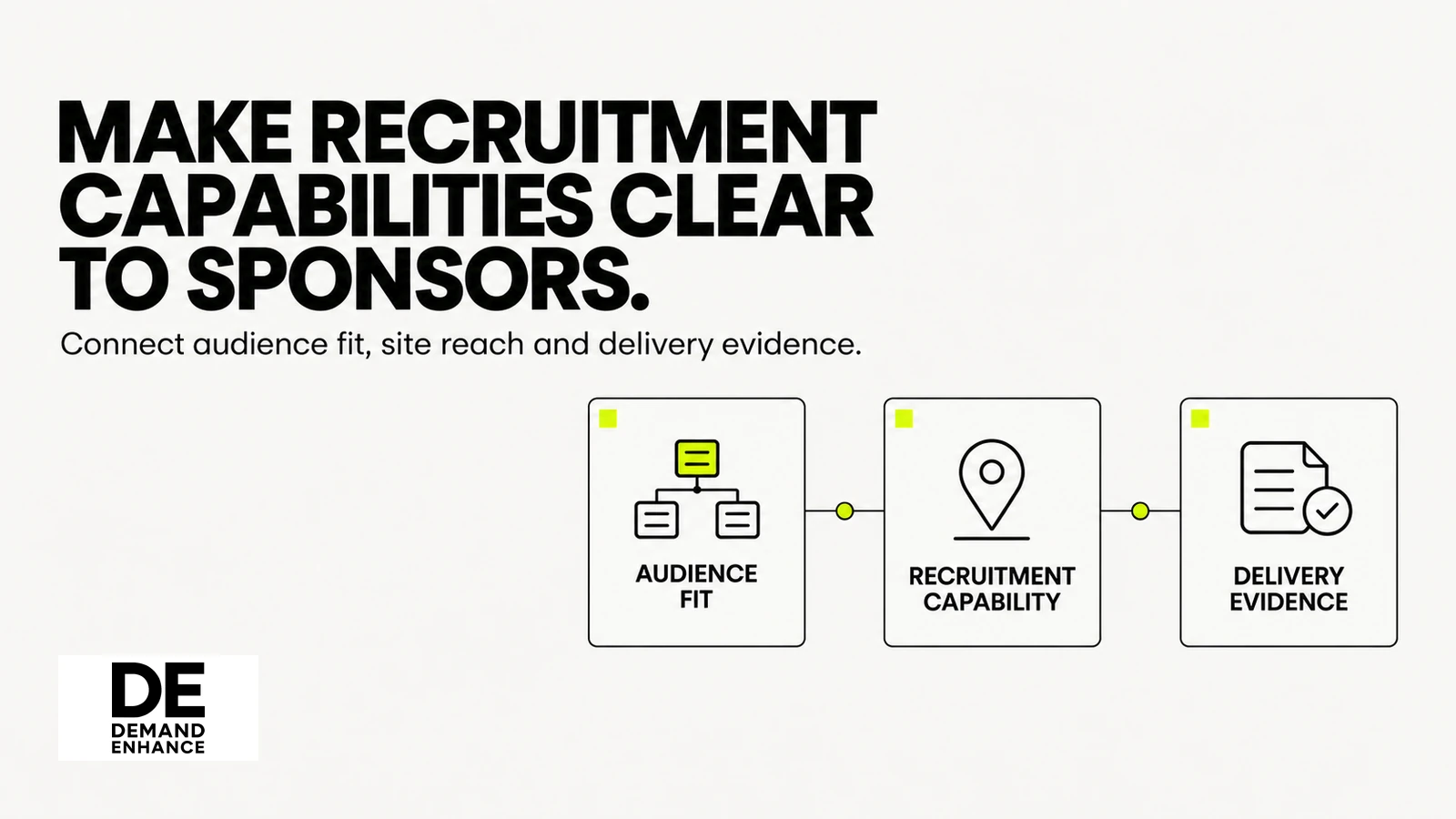
Corporate marketing for these operations requires a shift in perspective. Vendors often repurpose public-facing advertising materials for their corporate outreach. However, providing transparent, process-oriented documentation serves a completely different marketing function. A robust B2B marketing baseline documents what the vendor actually does. This involves communicating the structural boundaries of the service, logistical roles assumed by the vendor’s staff, and communication channels maintained with contracting organizations. Defining this identity means explicitly mapping out operational scope rather than relying on generalized descriptors.
Separate sponsor-facing positioning from participant-facing recruitment
One of the most persistent issues in marketing clinical trial recruitment services is the failure to distinguish between the corporate audience evaluating the service and the public consumer audience. By attempting to communicate with commercial buyers using the exact consumer-facing language constructed for public campaigns, providers risk obscuring their actual operational model.
To establish precise operational boundaries, vendors should isolate their sponsor-facing corporate messaging from their outward public campaigns. Trialbee’s opened sponsor page describes its own sponsor-facing recruitment offering and platform (https://trialbee.com/sponsors/), illustrating a public example of a distinct corporate narrative. Vendors can structure their marketing to describe their geographic footprint, documented procedural architecture, and data capabilities rather than relying on broad appeals.
Developing a dedicated corporate marketing stream involves distinct web architecture and content strategies. Vendors might establish meticulously segmented website navigation menus to separate internal staffing descriptions from their public-facing advertising. A distinct corporate pillar allows the marketing team to extensively detail business operations, organizational history, and project management methodologies. This separation extends into off-site marketing channels such as capability decks and professional profiles, allowing a clinical project manager to view them as a specialized vendor partner.
Sponsor-facing message checklist
- State who the corporate service supports, its operating scope, and where the provider's responsibilities begin and end.
- Verify any claims about channels, regions, screening, reporting, or technology against current documented operations with appropriate internal review.
- Publish project examples and metrics only with required approval and context that explains their source, period, denominator, and limits.
Put the idea into practice
Choose the sponsor-facing message
A recruitment provider's corporate page currently leads with participant campaign language. What should the B2B page emphasize instead?
Define the provider's operating role
Choose this when sponsor evaluators cannot see the service boundary. Explain supported work, regions, handoffs, and reporting practices that are verified, while keeping participant-facing content in its own audience context before writing broader value claims.
Add a contextualized example
Choose this when the service model is clear but needs evidence. Use a documented, approved example that states scope, period, inputs, and limitations; omit sponsor details and do not frame past performance as a forecast.
Document recruitment service boundaries
Separate the audiences
Identify which pages serve sponsors and which materials address participants. Keep the corporate message focused on the vendor's service and avoid blending public campaign language into operational evaluation content.
Map the workflow
Document confirmed responsibilities from intake through handoff, including reporting and communication structures. Include screening or platform details only when they are part of the current contracted service.
Review evidence context
For each metric or case example, verify source, period, denominator, scope, and permission. Present past work as a bounded example rather than a forecast for future studies.
Select a step to explore the idea.
Replace broad claims with a clear service definition
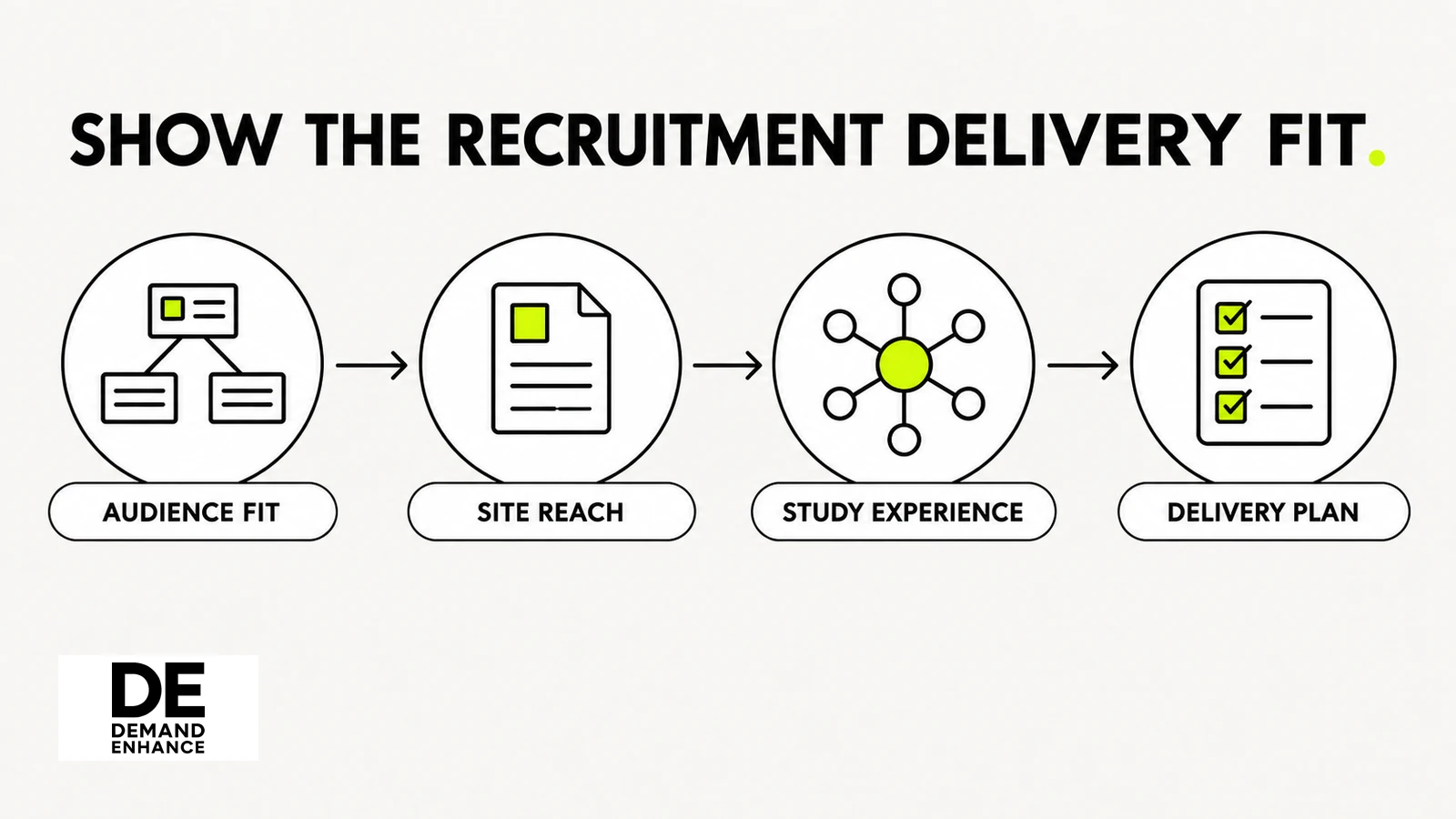
Corporate marketing frequently suffers from the overuse of broad, unsupported descriptors such as “seamless,” “accelerated,” and “innovative.” While these adjectives may fill space, they provide little evaluative utility to a commercial buyer analyzing external service providers. To sound professional and authoritative, service providers can systematically replace vague qualitative claims with explicit definitions of their actual organizational process.
Recruitment vendors operate via entirely different strategic models. Marketing a service effectively means documenting the parameters of the engagement. To replace generic claims practically, marketing teams might develop an internal positioning checklist before publishing any corporate web page. This checklist requires the vendor to explicitly state its true operational regions, actual marketing channels, and standard data reporting structures. The positioning checklist acts as an internal editorial standard. It demands a transparent description of the communication channels used by the vendor—whether through traditional print media, localized digital outreach, or specified organizational partnerships. Answering specific checklist items replaces superficial language with tangible business logic.
State who the service supports and where it fits
A highly detailed recruitment capability page explicitly defines its target audience and operational boundaries. A vendor might clarify whether their internal operations support early-stage studies, highly specific narrow cohorts, or expansive decentralized geographic models. Vendors should state the territorial ranges they cover and the types of corporate entities they typically support.
For instance, QPS’s opened recruitment page describes its own in-house recruitment service for early and late clinical trials (https://www.qps.com/service/study-recruitment-for-early-and-late-phase-clinical-trials/), illustrating a specific structural approach tied to their internal operations. The clinical research space features diverse service operations. A saved search result also covers clinical-trial recruitment vendor categories and evaluation (https://www.casrai.org/guides/clinical-trial-recruitment-companies), establishing that vendors differ vastly in their documented categorizations.
Importantly, marketers must distinguish their internal services from the broader remit of a full-service CRO. While a full-service CRO might manage comprehensive trial design and expansive regulatory logistics, a specifically configured recruitment firm might focus strictly on early top-of-funnel outreach. Ensuring this functional boundary is clear helps external buyers understand exactly which portion of the operational logistics the vendor manages.
Explain the actual recruitment workflow and handoffs
Rather than making general assertions about continuous project support, providers can document their internal procedural handoffs. This means detailing the sequence of events from the start of a vendor’s contract to the point where their corporate responsibility concludes. A substantive B2B marketing strategy describes the operational steps a vendor takes to execute their work—whether through specific digital media curation or established community networks.
If a recruitment workflow involves distinct provider-specific tasks—such as performing preliminary phone screening, completing electronic health record (EHR) screening steps, or hosting a proprietary site communication portal—the vendor should specify these tasks only if they are actively part of the formal service being offered. Explaining exactly where the vendor’s administrative responsibility ends demonstrates a mature understanding of trial logistics without unnecessarily detailing patient-level clinical protocols.
Marketing copy should also describe the vendor’s standard data transparency structures. The corporate copy can outline the formatting standards of internal reporting, such as specifying whether they utilize daily operational summaries, weekly aggregate spreadsheets, or static monthly reports. If a provider utilizes an internal software platform to log inquiries, the materials can describe the basic architecture of that platform. Explaining the structural boundaries of a vendor’s role—detailing exactly what information is collected, how it is formatted, and the mechanism used to transfer it—creates a highly transparent B2B narrative.
Show evidence responsibly
AI SEO can support review of niche therapeutic enrollment queries and how recruitment capabilities are described. After a scoped pilot and competitive audit, teams can draft format recommendations; clinical operations and site owners should verify network, workflow, and service details against current documentation before publication.
In B2B corporate marketing, evidence is paramount. However, simply presenting isolated figures without necessary external context limits their usefulness. Experienced commercial evaluators may view sweeping numerical claims with skepticism. When presenting recruitment metrics online, the objective is to demonstrate methodical competence, not to rely on unexplained statistical figures.
Showing evidence responsibly means accurately defining the source, scope, period, role, and limits of any highlighted service example. Vendors must contextualize any historical metric, abstaining from positioning historical project values as unquestionable performance metrics for future unexamined work. A disciplined marketing approach documents the timeframe during which an example project took place, the exact operational tasks assigned to the vendor by the contracting organization, and the geographical scope of the work completed. Additionally, a vendor must define the specific internal administrative resources allocated to that past effort. By explaining evidence generically and prioritizing structural accuracy over predictive assertions, marketing materials ensure that documentation records the work performed.
Define the denominator and source for any reported metric
The utility of any reported operational metric fundamentally relies on defining its denominator and specific origin. If a vendor advertises a specific internal procedural outcome, the accompanying corporate copy must explain the population source and the strict filtering criteria applied internally to generate that precise point. Was this metric generated via an internal outreach network over a strict two-month window, or was it derived from broad, untargeted web traffic continuously running for a full year? Was the documented scenario isolated to a highly specialized cohort, or does it reflect an aggregate corporate benchmark spanning multiple unconnected organizational campaigns?
Metrics cited in corporate materials carry weight when meticulously documented. A robust marketing summary explicitly outlines the baseline data behind any highlighted figure. For example, if a vendor reports on administrative processing averages, the marketing copy should document if that metric represents an isolated, vendor-managed pilot program or if it constitutes year-long corporate averages. Providing rigorous context allows evaluators to conditionally review the structural environment in which previous work occurred. It clearly establishes that historical metrics are simply snapshots of past operational inputs.
Use case examples only with permission and documented context
Publishing case studies and operational examples is a standard B2B marketing tactic. However, within this corporate space, these tools require robust documentation and clear permission parameters. Case examples should focus exclusively on the vendor’s internal operational methodology—such as navigating a complex multi-language advertising deployment, or structurally coordinating internal staff scheduling during a massive process rollout.
Any specific sponsor details or vendor timelines must only be published if explicitly verified and permitted by the contracting sponsor. A well-constructed case example builds a chronological narrative of how a vendor adapted internal administrative procedures to support specific logistical hurdles. It concisely documents the real administrative inputs and process management layers handled by the vendor’s staff, ensuring that all published details remain strictly within confirmed, authorized context boundaries. Marketing materials can expand on notes like the duration of the operational phase or the size of the internal vendor team deployed. By breaking down logistical challenges using clearly stated operational records, marketers build professional trust without making inappropriate outcome-level assertions.
Explain how the provider works with sponsors, CROs, and sites
The commercial research market relies on interconnected organizational tiers, including overarching management companies, independent evaluation firms, and direct contracting sponsors. A recruitment provider cannot pretend to operate in a vacuum. Effective B2B marketing material explicitly details how the vendor integrates into this broader hierarchy based strictly on their real, documented business practices.
A vendor might state whether they typically contract directly with an independent commercial sponsor as a distinct asset or if they standardly function as a specialized operational subset managed under a global corporate partner. Beyond initial commercial contracting, the vendor should also openly explain its actual, day-to-day interaction model with external coordination facilities. Rather than making extensive claims about universally reducing administrative workloads, the vendor should strictly detail its accurate communication procedures.
If the vendor routinely manages interactions with external administrators, the provider should outline the formal process used by their team. It may detail the designated frequency of administrative updates, the formatting of external communication messages, or the specific software structures adopted for fundamental data transfers. Detailed marketing copy prioritizes structurally definitive explanations of actual inter-company communication and data handoff processes, firmly rooting the service operation in practical business workflow reality rather than broadly applied institutional compliance assumptions.
Build a useful next step for a study-specific conversation
The fundamental objective of a specialized B2B marketing strategy is to facilitate a structured, highly specific initial corporate dialogue. Marketing campaigns that blanket-push for a general sales demonstration often fail to account for the technical complexity of commercial enrollment planning. To translate professional traffic into a qualified dialogue, recruitment providers can structure their corporate website’s architecture to encourage buyers to share high-level, non-confidential service requirements.
For B2B marketers, mapping out how to connect SEO, PPC, and LinkedIn Ads for life science lead generation means connecting useful content to a clear, non-confidential next step. A generic form should request only the high-level context needed to route an initial conversation, such as the service area and broad timing, without requesting protocols or participant details.
A provider can invite a prospect to contact the team with a short, non-confidential description of the service under consideration. The page can say what information is useful for an initial conversation without requesting protocols, participant details, or other sensitive material. The guidance in how to measure lead quality from SEO in long sales cycle life science companies can help marketers distinguish a relevant conversation from a raw inquiry.
Frequently asked questions
Why separate sponsor-facing recruitment marketing from participant outreach?
Sponsors evaluate a provider's service scope, operating model, geography, reporting, and handoffs. Participant-facing materials have a different audience and purpose, so combining them can obscure the corporate service being offered.
Which recruitment metrics belong in public marketing?
Only publish metrics that are documented, approved, and presented with their source, period, denominator, scope, and limitations. Historical examples describe a past context; they should not imply that a similar result is assured for another study.
What workflow details can a recruitment provider describe?
Describe only tasks and handoffs that are part of the current service, such as communication or aggregate reporting processes. Avoid patient-level clinical instructions and do not claim integrations, screening steps, or responsibilities that the provider has not verified.
Sources and further reading
Demand Enhance
Clarify sponsor-facing recruitment positioning
Discuss how your recruitment service can explain its verified role, workflow, and sponsor handoffs with Demand Enhance. Bring current service documentation and any approved examples or metrics you may want to reference.
Discuss your priorities